Monday, April 9, 2012

Holy Week

http://walkinjerusalem.blogspot.com/
by Fred & Gloria Strickert

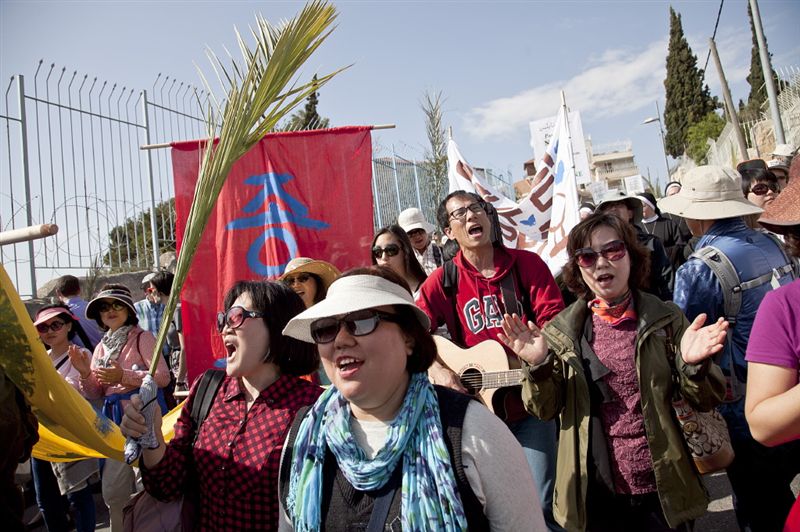
Palm Sunday in Jerusalem
Thousands of Pilgrims Converge on Jerusalem

Beginning at Catholic Church in Bethphage .
Crossing East Jerusalem and the Mount of Olives.
 down the Kidron Valley to the Old City
Led by Palestinian Scout Troops--Here from the Syrian Orthodox Church. 
Palestinian Christians still remain a small minority overshadowed by the thousands of pilgrims. Here young women from Beit Jala -- just seven kilometers away, but across the separation barrier-- were given permits for the Holy Days.
The irony: Christians from all over the world have free access to all the holy sites, but those from nearby need special permission.  In many cases, one spouse received a permit while the other did not.  And with the frequent closure of checkpoints during these holy days, permits were often meaningless pieces of paper.
Palm Sunday procession of priests in the Church of the Holy Sepulchre around the tomb.
Maundy Thursday


Catholic foot-washing ceremony at upper room.

Eucharist at the Lutheran Church of the Redeemer.


Procession from Redeemer to Gethsemane


Stay with me! Watch and Pray!


Good Friday on the Via Dolorosa 


Lutheran-Anglican Service at dawn.   Station V: Simon of Cyrene is compelled to carry Jesus' Cross


Pilgrims take up their cross to follow.

Good Friday Arabic meditation at Redeemer at sundown with Vicar Ashraf Tannous.
Easter Sunrise


Very early on the first day of the week, when the sun had risen, they went to the tomb. (Mark 16:2)


God breaking the silence:       He has been raised;     he is not here.


Go  and Tell!


photo credits: Ryan Roderick Beiler & Michael Younan
by Fred & Gloria Strickert
http://walkinjerusalem.blogspot.com/

Friday, March 30, 2012

Blind Bartimaeus

http://walkinjerusalem.blogspot.com/
by Fred & Gloria Strickert

“Teacher, order your disciples to stop.”
Jesus answered, "I tell you, if these were silent, the stones would shout out.”
(Luke’s Palm Sunday Gospel—Lk 19:40)


Just a few days before Palm Sunday and the beginning of Holy Week, while passing by Jericho on this way to Jerusalem, Jesus encountered Blind Bartimaeus  (Mark 10:46-52).  This was the last miracle of Jesus according to Mark’s Gospel.  Perhaps the most surprising part of the story is that “many sternly ordered him to be quiet,” trying to prevent healing for this unfortunate member of God’s creation.  Yet Bartimaeus only cried more loudly until he got Jesus' attention.

It happened again this week.   People trying to prevent “the recovery of sight to the blind.” And it happened near Jericho, at the Allenby Bridge border crossing from Jordan.

Dr. Ali Dabbagh, an eye-doctor with specialist credentials, was on his way to Augusta Victoria Hospital in Jerusalem to offer his third segment of a course on “Diabetes and Eye Complications.” 
And he was denied entry by Israeli security.  He tried another border crossing the next day, and was denied once again.

This is one of the many road blocks thrown up every day by a government of occupation in making life difficult for Palestinians.  It highlights even more the amazing story of our Lutheran ministry of health care to Palestinians at August Victoria Hospital--especially when one considers all the determination by health care providers and all their extraordinary efforts.  We were made aware of this story once again this week with the release of the LWF Jerusalem Annual Report --2011 (click the link to read the report or go to the website  www.lwfjerusalem.org ).

When you see a beautiful cover photo of a young Palestinian dialysis patient with her Winnie the Pooh coloring page, you can only feel proud about what the world-wide Lutheran community is doing to continue Jesus’ healing ministry.  You can also read the story of Asmah, a six-year old cancer patient who came to AVH from a refugee camp in Gaza.  On page 12, you can read about the celebration at AVH of World Diabetes Day and the hospital's focus on childhood diabetes—with funding assistance of USAid.


14 % of Palestinians suffer from diabetes, the high figure a result of the stress-filled life under occupation—and in many cases it affects the eyes, no different than the world Jesus encountered with Roman occupation.

 
There are 66 ophthalmologists and 12 eye specialists for the Palestinian community, but none have been trained in diabetic eye problems.  Thus the importance for a specialist like Dr. Dabbagh who is a British citizen working in a hospital in Kuwait.  For the last thirteen years he has been donating part of each year working with Palestinian patients, establishing the Oyooni Mobile Clinic.  (Click for the clinic's webpage)


And so the importance of Dr Dabbagh’s courses at Augusta Victoria Hospital.  What a gift he offers to diabetic patients throughout Gaza and the West Bank, and particularly those coming to AVH for treatment.

What a disappointment for those who had come to the hospital on Tuesday expecting to learn from  him.  What a tragedy for individuals who continue to suffer because of such unnecessary delays.

Fortunately the Israeli newspaper Haaretz reporter Amira Hass heard about the denial of entry of Dr. Dabbagh at the border this past Monday and again at another border crossing on Tuesday and decided to investigate. The reporter’s inquiry at the Israeli Interior Ministry provided the explanation that he “was refused entry at the recommendation of defense elements.”  As a result of her prodding, there was typical beaurocratic backtracking-- no he really wasn't a security risk-- and  eventually the decision was reversed.  

Haaretz published the Friday story “Israel reverses decision denying entry to British-Palestinian humanitarian doctor.”  (Read the newspaper story here.)
By Thursday Dr. Dabbagh was finally allowed to enter--three days after his original planned arrival.  He was merely delayed.  One wonders how many others have experienced the same unwarranted roadblocks?  How many other humanitarians have been denied completely?

In the story of blind Bartimaeus, when many sternly ordered him to be quiet, he refused. Bartimaeus  cried out even more loudly, “Jesus, Son of David, have mercy on me!” 
 Let’s pray for more determined individuals like Dr. Dabbagh and for more voices like Haaretz’s Amira Hass to continue crying out even more loudly to bring an end to the occupation.
"I tell you, if these were silent, the stones would shout out.”

by Fred & Gloria Strickert

Saturday, March 24, 2012

Wilderness

http://walkinjerusalem.blogspot.com/
by Fred & Gloria Strickert

Jesus was in the wilderness forty days, tempted by Satan, and he was with the wild beasts; and the angels ministered to him.  Mark 1:13


Lent is the season for wilderness walking.


The perfect time for a congregational outing to the wilderness east of Jerusalem.

  
            A Picnic Lunch
One does not live by bread alone--a little peanut butter & nutella, please-                                                                       
Our destination: St. George's Monastery in Wadi Qelt --the valley cutting through the wilderness from Ramallah to Jericho.  In the 5th-6th centuries, over one hundred monasteries covered the wilderness landscape around Jerusalem and Bethlehem.

The hike down
The view from below
Beginning with the monk Chariton in 330 ce, Christians began the practice of a Lenten pilgrimage to the wilderness, living in caves in the rugged landscape and then joining together each Sunday in the monasteries for their weekly Eucharistic feast.  Note the date:  When Christianity was legitimized and became main-stream under Constantine, and when persecutions and hardships were less frequent, the faithful felt the need for such Lenten discipline.


Note the caves to right of Mona- stery.   Tradition said that Elijah stayed here on way to the Sinai.The monastery was destroyed several times and later rebuilt, most recently in the late 19th century.

The winter rains in Jerusalem and water from a spring transform the Wadi into an oasis. 

Inside the monastery chapel: Iconostasis with traditional Greek Orthodox icons.
Icon of St. George of Koziba and his relic box (skeleton)- the monastery's leader in the late sixth century. 

Playing with the monks' pet dog.
Women are welcome to visit St. George's, unlike many other Orthodox monasteries.  Tradition says that Joachim, the father of Mary of Nazareth, had retreated nearby when he learned that his wife Anna was pregnant with Mary.  Later in the 6th century, a Christian noblewoman following a vision of the Virgin Mary came here and was healed.
The view below 
The trek back up, by donkey.
Our wilderness trip was capped off by a visit to Nabi Musa, a Pilgrimage site of Palestinian Muslims in honor of the Prophet Moses.
Greetings from the Wilderness, with the Dead Sea in the background and Mount Nebo beyond the Jordan.

by Fred & Gloria Strickert

Photo credits: Laurin-Whitney Gottbrath & Anna Johnson


Saturday, March 10, 2012

Women's Day

http://walkinjerusalem.blogspot.com/
by Fred & Gloria Strickert

Thursday was International Women’s Day.


In the Palestinian community, this is a day off of school and in many cases women are given the day off work for special women’s gatherings and forums.

Among Israelis, Women’s Day was overshadowed by the holiday Purim which focuses on a biblical role model Esther who saved her people from annihilation.


It was my weekly afternoon to teach my Old Testament class at Dar Alkalima College and appropriately our topic was the Genesis matriarch Rachel, an exemplary woman of faith, patience, and hope; the mother who gave her life in childbirth; the caring figure who continues to weep for her children displaced from family and home. With Rachel’s Tomb recognized as a Bethlehem landmark for two millennia, and as once accessible to expectant mothers of all three monotheistic religions, one might have expected the kind of familiarity of an oft mentioned favorite daughter.


Yet politics does strange things. The surgical amputation of this historic site from Bethlehem by the separation wall has left most of my class members without any visual memory of the quaint little shrine that stood open to all. So they were attentive as I shared historical photos and drawings and reports from visitors of all three faiths.

One of the difficulties teaching this class of mainly West Bank students is that they aren’t allowed to see with their own eyes Jerusalem sites just a few miles away.

There is one exception. Salma, a mother of four including one a high school senior, is from East Jerusalem and drives each day for class, now in her upper thirties and wanting to get a college education—a good example of what Women’s Day is all about. At first I had assumed that she was Christian –my class is divided evenly between Christians and Muslims. After all, she did not wear the traditional Hejab (headscarf), and I had to pry her away from her King-James-Version Bible in favor of our NRSV study Bible textbook. Then she explained how as a little girl she got in the habit of reading the Qur’an for hour upon hour during the annual Ramadan fast. And later she added Bible reading to increase her understanding. So now she’s taking a class in Old Testament and running circles around both Christian and Muslim students in her knowledge of both holy books.

Yet there is one thing that stumped her. “Can you tell us about Purim?” she asked after our mid-afternoon break.

“It’s about Esther,” I started.

“. . . And how she saved the Jewish people from annihilation,” Salma interrupted.

Some of the others nodded their heads familiar with the story.

“But how can a woman like that demand the killing of all the Persians?” She asked.

“Really? Is that in the Bible?” one of the Christian students responded.

Yes. I’m afraid so. 75,000 persons slaughtered in revenge for one crazy power-hungry man named Haman. There’s a reason I skipped over this book in my 24 years of college teaching. Isn’t the Bible supposed to be about love and forgiveness?

“They were enemies,” one of the male students explained.

“But Esther was a woman,” Salma answered in disbelief. “She wouldn’t kill all those children.”

The Palestinian women’s committees called on people to remember women who have made an impression, teachers, women in government, business women, mothers.

So which matriarch should we admire this Women’s Day? Rachel weeping for her children? or Esther rescuing her children and then rendering vengeance upon her enemy?


That evening we pulled up to the Bethlehem check point about 7:30. The queue was backed up about a quarter of a mile with tour buses heading back to their Jerusalem hotels and Jerusalem residents heading back home after a day in Bethlehem for school, for work, for a visit to mothers on women’s day. The queue was moving faster than unusual and within 45 minutes we would make it to the front of the line.  We were the lucky ones.  Those from Bethlehem fortunate to get a travel permit had to walk through the maze on foot.


In the car ahead of us, we noticed a head bobbing up and down—a child being entertained trying to make the time pass more quickly. Been there, done that. Today we had our Kindles, and slowly, slowly, we inched forward toward the security guards. They didn’t appear to be checking very carefully tonight. Occasionally they would ask a driver to open the trunk for a quick glance and wave them through.

Now we were one car back, and it would be just a matter of minutes.

Wrong!

Tonight there was a woman soldier doing the inspection. And second male guard stood back a distance and watched with gun in hand. The woman soldier put her head part way in the open window and seemed to signal the driver to get out of the car where he handed her his documents for inspection. The license plates showed that they were Jerusalem residents. Nothing out of the ordinary. Then the soldier walked to the back of this small SUV motioning for him to open the door. He did. Right before our eyes we could see there was no reason for concern. She pointed at a yellow plastic bag. He held it upside down. Empty. Then another. Then she rolled up the floor mat. Then a walk to the front to inspect under the hood. Then opening the front passenger door, the young woman soldier climbed in with her rifle dangling from her shoulder, apparently searching under the seats and above the vizers. Back outside she signaled the young man to open the back door. He reached in and lifted his one-year old child out of the car seat while his wife crawled over it to get outside. Again with rifle dangling, the woman soldier climbed in to search apparently under the car seat and in the diaper bag. Nothing. All the while the young couple stood patiently waiting, looking much like the students in my class, wearing jeans and nice tailored shirts. And the young mother wearing her hejab. In the states we’d call that “probable cause.” We’ve seen it often enough. Racial profiling. Religious profiling. Car after car passing quickly through with hardly a passing glance. No security threat here. But the woman wearing the hejab was cause enough for concern. Even with her one-year old child.


Photo illustrative of the Palestinian mothers who walk through the checkpoint each day.

So for International Women’s Day 2012, if there is one woman who stands out in our minds to remember, it’s this nameless mother—like the hundreds of women going through security each day--dressed in her hejab, patient and quietly waiting while on the way, at the checkpoint by Rachel’s Tomb.

by Fred & Gloria Strickert
http://walkinjerusalem.blogspot.com/

Saturday, February 25, 2012

Mitri, Mabruk!

http://walkinjerusalem.blogspot.com/
by Fred & Gloria Strickert

Congratulations to Mitri Raheb!
Mabruk!

Last night, our good friend and colleague Pastor Mitri Raheb was awarded the prestigious Deutscher Medienpreis in Baden-Baden, Germany.

This is an award that has been granted to individuals such as Nelson Mandela, the Dalai Lama, Bono, Kofi Anan, Queen Rania of Jordan, Hilary Clinton, Angela Merkel, and Rudy Giuliani.  The former President of Germany, Roman Herzog, read the citation to honor Mitri.


The selection committee stated that the decision of the jury to give the award to Rev. Dr. Raheb was based on his tireless work in creating room for hope for his people, who are living under Israeli Occupation, through founding and building institutions of excellence in education, culture and health.

We first got to know Mitri in 1989, shortly after his return from Germany with a doctorate in theology and his ordination as pastor of the Evangelical Lutheran Christmas Church in Bethlehem.  At that time, he spoke hardly a word of English and gave us a tour of the church in German, describing his dreams for the future.  At that time it was evident how the congregation had suffered under occupation.  Little did we know that this young idealistic pastor was a man of vision, who had the faith and courage to carry out those dreams.

In 1991 during the first Gulf War, while the whole city of Bethlehem was under curfew (basically a whole people living under house arrest), Mitri wrote a book I Am a Palestinian Christian in which he awakened those of us in the West that there were Christians living in the Holy Land today--yes even Lutherans--and that most Palestinians were ordinary folk who simply wanted to make a decent living and provide a safe and secure atmosphere to raise their families. In doing so he would have to debunk the popular media image that Palestinians were terrorists and expose the expansionist political agenda of Israel that attempted to legitimize occupation and the confiscation of Palestinian lands for colonies called settlements.  It was not long before Mitri had become a popular speaker in venues all around the world.


We both had the pleasure of working with Mitri at the Lutheran Church in Bethlehem in 1995-96 as ELCA global mission volunteers, where we accompanied him for one year in assisting him in promoting the life and culture of Bethlehem.  One of our projects was to co-author a book on the history and culture of Bethlehem, Bethlehem 2000:  Past and Present,  in anticipation of the millennial celebrations in the city of Jesus' birth.    [Link to description  of book.   Link to reviews in German press.    We're currently working on a new book to promote local culture.]
Sadly the Bethlehem 2000 events and the progress that had been made were crushed under the second Intifada -- described in Bethlehem Besieged                                   Nevertheless, Mitri would still not be deterred, as his subtitle suggests: Stories of Hope in Times of Trouble.   His work has continued with the building of a new state-of-the-art k-12 school Dar Alkalima, the establishment of the first Lutheran College, a wellness center with swimming pool, exercise rooms, yoga classes, and clinics, and now a Gymnasium in process -- all at the southern end of Bethlehem.  Today the campus of the Lutheran Church in the center of town includes a guesthouse, restaurant, art gallery, convention center with large auditorium, and guest house (Dar Annadwa).  The center is actively publishing scholarly Arabic studies, encouraging preservation of classic Arab architecture, and promotion of music, Arab dance (dabka), the arts, and film.                           


Foremost, Mitri is a pastor, feeding his congregation with challenging sermons and inspiring the youth not to give up hope. 
So again, we raise our voice:  Mabruk! Mitri.  This is a well-deserved honor.

Those of you who know Mitri will celebrate with him this award.  You will also be disappointed by the following.

Sadly, this is not the end of the story.  The last several weeks The Jerusalem Post has decided to follow a campaign of character assassination with no less than three stories of quotations out of context and libelous labels.  One headline actually read Israel Slams Award to Anti-Semitic Pastor.  And the Israel Embassy in Germany did their best to pressure the former German President and the founders of the prize to withdraw this award. 

Before going one step further, we can say loud and clear, "Mitri is not anti-Semitic!  He is not racist!"  He is nothing what these articles claim him to be.  Yet Mitri has been smeared in the press and across the internet by individuals who do not know Mitri, but who seem threatened when a Palestinian pastor is so honored.

Interestingly, all three articles were written not in Jerusalem, but by an individual who is part of a right-wing think tank in Berlin who is shoveling his trash to the Israeli Embassy in Berlin and to the Jerusalem Post newspaper.

It is quite clear that neither the author or the embassy personnel he supposedly quotes has even read what Mitri has written or heard his lectures.  According to the JP article, one of his sins is that he is involved in the "Cairo Document" which sounds like some gathering in Cairo, Egypt.  Most likely this is a hearsay reference to the "Kairos Document" which, for anyone who has read it, makes clear the reference to the Greek word for "the opportune moment" and which focuses not on hate, but on a moment of faith, hope, and love.  So, if they could not even take the time to get the title right, would anyone expect them to know what this document is about?

A simple google search of the JP articles' key words and phrases shows that the Berlin source was an online article written by a Jerusalem expatriate who seems to want to discredit Palestinian Christians whenever the opportunity arises-- and that includes taking phrases out of context and using labels that defame. 

Last Wednesday at our interfaith group, our Jewish Rabbi counterparts shook their heads in disbelief.  "Anyone who knows Mitri, knows he is none of these things," one summed up the feelings of the group.

Yet once a label appears in print, it's almost impossible to correct, erase, or detract.  Opportunists will be quick to jump on the bandwagon.  And the defamation will continue.

In the meantime, those who know Mitri are standing up to congratulate him. See news releases of the Lutheran World Federation and the World Council of Churches , the latter referring to Dr Raheb as "a person with immense integrity."  

The leadership of the church in Germany has spoken out on his behalf, the granters of the prize have refused to bow to pressure to withdraw the prize, and the former president of Germany Roman Herzog proudly stood before the cameras and microphones to honor our dear friend and colleague, Pastor Mitri Raheb.
Last night, Mitri Raheb spoke to the world in receiving this award, that only when we flee from the temptation to demonize the other, and when we truly listen in our encounter, then there is the possibilty of peace.  His entire speech can be found online here. 

"We said, firstly, that the Holy land does not need walls but bridges. That is why we called our centre “Dar annadwa”, Centre for International Encounter. Martin Buber, the Jewish philosopher, whose thinking is very significant for me, was right when he wrote, “All true life is encounter.” The “thou” of the other person gets a face and a name through encounter. Dialogue can only be true dialogue if it is a dialogue between people with equal rights, if the “thou” and the “I” stand face to face. If each person can have their narrative, their history and identity, but also listen to the narratives of the others."   (Mitri Raheb in accepting the award.  Feb. 24, 2012)

Mabruk!  and Shokrun, Mitri

by Fred & Gloria Strickert


Thursday, February 16, 2012

Salaam Hon!

http://walkinjerusalem.blogspot.com/
by Fred & Gloria Strickert


"So what do you think of our village?" the elderly couple asked.
"Salaam hon," we replied.  "It's peaceful!"  or more accurately "Peace is here."


What can be more peaceful than a village where its elders gather to discuss business around a tree?

What can be more peaceful than a village nestled between the hills with the fertile fields turned green by the winter rains?

What can be more peaceful than a place where people want nothing more than for their children's dreams to be fulfilled.


This is a blog about the village of al-Aqaba in the far northeast corner of the West Bank (not to be confused with Jordan's seaport Aqaba on the Red Sea or another Palestinian village Aqraba southeast of Nablus).

For us al-Aqaba provided a welcome respite from the noise and clammer of the city, the fast-paced and stressful life of Jerusalem.  The pastoral setting, the unseasonably warm sunny day, and the simple life-style of al-Aqaba can be deceiving.  Peace here?   You have to be kidding.  When you hear the story of the last forty years or so (and we'll come to that later), you'll understand why many would hesitate to use the words peace and al-Aqaba in the same sentence.  You'll understand why residents of al-Aqaba could remain pessimistic about the future.  You'll understand why the residents of this small village would have every reason to be suspicious of visitors from the outside.  Instead the welcome mat was rolled out for us.  Ahlan wa Sahlan!  They would teach us what it is that makes for peace.

Why would this modern-day Abraham and Sarah not be suspicious also of us arriving at their "tent" unexpected?  Instead they insisted that we sit down and rest a bit and share a cup of tea. "Try some of our fresh picked lettuce."   "Now you need some coffee."  We laughed watching their two grandsons play on a make-shift swing hanging from a shade tree.  That was a topic we both understood, "And how many children and grandchildren do you have?"  They more than doubled us.  And then two more came walking home from school with their backpacks and a hunger for an after-school snack before starting their homework.  Salaam hon!  Peace is indeed here!

For our visit to al-Aqaba we were accompanying one of our congregation members, Morgan, whose great-grandfather, as it turns out, was my seminary homiletics professor.  We often describe our congregation as a servant-congregation--made up of a significant number of young volunteers who are here to serve for anywhere from three months to a year.  And on any given Sunday while we are engaged in Word and Sacrament in our Redeemer chapel, the majority of them are embodying Christ's love in the communities they serve in Jerusalem and throughout the West Bank from Hebron in the South to a place like al-Aqaba in the north.  What is amazing is how they manage to get to church as often as they do, like Kathy from the Christian Peacemaker Team in Hebron, making connections via three or four buses, passing checkpoints, and various hurdles just for the opportunity of being in community.

So on this past Sunday morning, when Morgan managed the long trek from al-Aqaba to Jerusalem for our Sunday worship, she mentioned that she had to stay in Jerusalem for an afternoon meeting.  Gloria and I looked at each other and were quick to volunteer to drive her back in exchange for a place to stay over night and a tour of the village and a chance to learn about her work there.

Morgan and the small guest house she manages for the village of al-Aqaba.   
Morgan learned about al-Aqaba through an online search of Palestinian towns and villages where she might be able to contribute her talents to the life of people.  An American-based organization called Rebuilding Alliance (click to read more) had assisted in building a school there and was looking for someone to teach English. In addition, Morgan assists mayor Haj Sami Sadeq in community development projects with a goal of bringing former al-Aqaba residents back to their homes as well as outsiders to visit this location off the beaten path. 

The message of welcome is the first thing visitors see.

Today there are only 300 villagers who have remained steadfast, a drastic change from the mid-sixties when over a thousand persons enjoyed the idyllic setting.  Then came the 1967 war and occupation.
Unlike the rest of the Israeli Occupied West Bank where expanding settlements are the problem for Palestinian villagers, The Israeli Defense Force decided to use this part of Palestinian land for military camps.  In the map below, al-Aqaba is in the center.  Further to the east large military camps are designated by the reddish brown color.  Eight smaller camps totally surround the village.

These include the elite ( = ruthless) Golani Brigade who carry out regular training exercises in these hills and, at times, within the village itself.  Yes, you read that last sentence correctly.  A military brigade that practices within an occupied village, among real live human beings trying to carry out their daily lives.

The first "accident" occurred in 1971, when the then sixteen-year-old Sami Sadeq (now mayor) was helping his parents in the fields and was shot with three bullets.  An IDF ambulance took him to an Israeli hospital in Afula where they were able to remove two bullets from his spine, leaving him paralyzed from the waste down.  The third bullet remains lodged to this day next to his heart. 

The amazing part of the story was that Sami did not give up.  He chose to remain to work through the system to help his relatives stay steadfast on the land.  While in the hospital during those months following the shooting, he spent all his energies learning Hebrew to aid in communication.


Over the years another eight villagers were killed and another fifty were wounded by the military exercises.  Perhaps the most bizarre story that we were told was that the IDF practiced night raids in the village itself to prepare for the 1982 invasion of Lebanon, because the village was similar in structure to many in Southern Lebanon.  Not surprisingly, three-fourths of the residents moved out to  the neighboring village of Tayasir or to the city of Tubas to the West.  There was no compensation.  They simply lost everything and had to start over again.  How could they dream of peace under these conditions?

That evening we spent in al-Aqaba seemed so peaceful, so quiet.  The sleep was so restful until 3:00 in the morning when I awoke to the sound of gunfire.  Another practice round for night time raids.   I wondered what must be going through Sami's mind or the grandparents of the four children we met.  Salaam Hon? 

Yet Sami has remained steadfast.  And there have been small victories.

After years of legal arguments and numerous appeals, the Israeli High Court in 2001 finally ruled that the military camps adjacent to the village on the west must be removed and that the IDF could no longer use the village for military exercises.  The small hill in the photo below (just beyond the houses) was the site of one of those camps.


Villagers feeling relieved and perhaps a bit optimistic, began rebuilding with simple homes that would be more than adequate lifestyles.   They planted gardens and invited former residents to return.  A morning walk around the village showed us signs of progress, houses just completed and foundations of others being layed.  Salaam hon?

Mayor Haj Sami Sadek felt they needed more than just new homes.  If they were really thinking about the future, the key would be a kindergarten.  Here is where Rebuilding Alliance entered the picture, offering educational expertise and funding to complete the building in 2004.  Click to see a Youtube video about the al-Aqaba kindergarten.   It was a brilliant idea.  There were no kindergartens in the villages located to the west.  So every day school buses and private vehicles bring children to al-Aqaba, many of them families originally from the village.


Today 130 students are enrolled in the kindergarten.  As we toured the classrooms where the children were engaged in singing and in group play, the mayor was outside supervising another building project, a roofed playground for the children to play outside on rainy winter days. Nearby there is an elementary school.

The positive court ruling and the progress taking place in the village paved the way for foreign governments to get involved, including funding from USAid for the paving of a road. The Japanese Embassy erected a new water tank and provided a truck (see photo of truck next to the meeting tree above) to bring water from a neighboring village  (the old water supply had been destroyed by the IDF), the British Embassy paid for a clinic, and the Catholic Church is considering offering a plot of land for a birthing center.


Japan, Norway, and Belgium provided funds to build additional floors on top of the kindergarten for economic development projects including a tea-bag factory and a sewing coop that exports dresses to Canada and the USA, where young women and men can find employment, and where mothers can coordinate their hours  while the children are in school. 

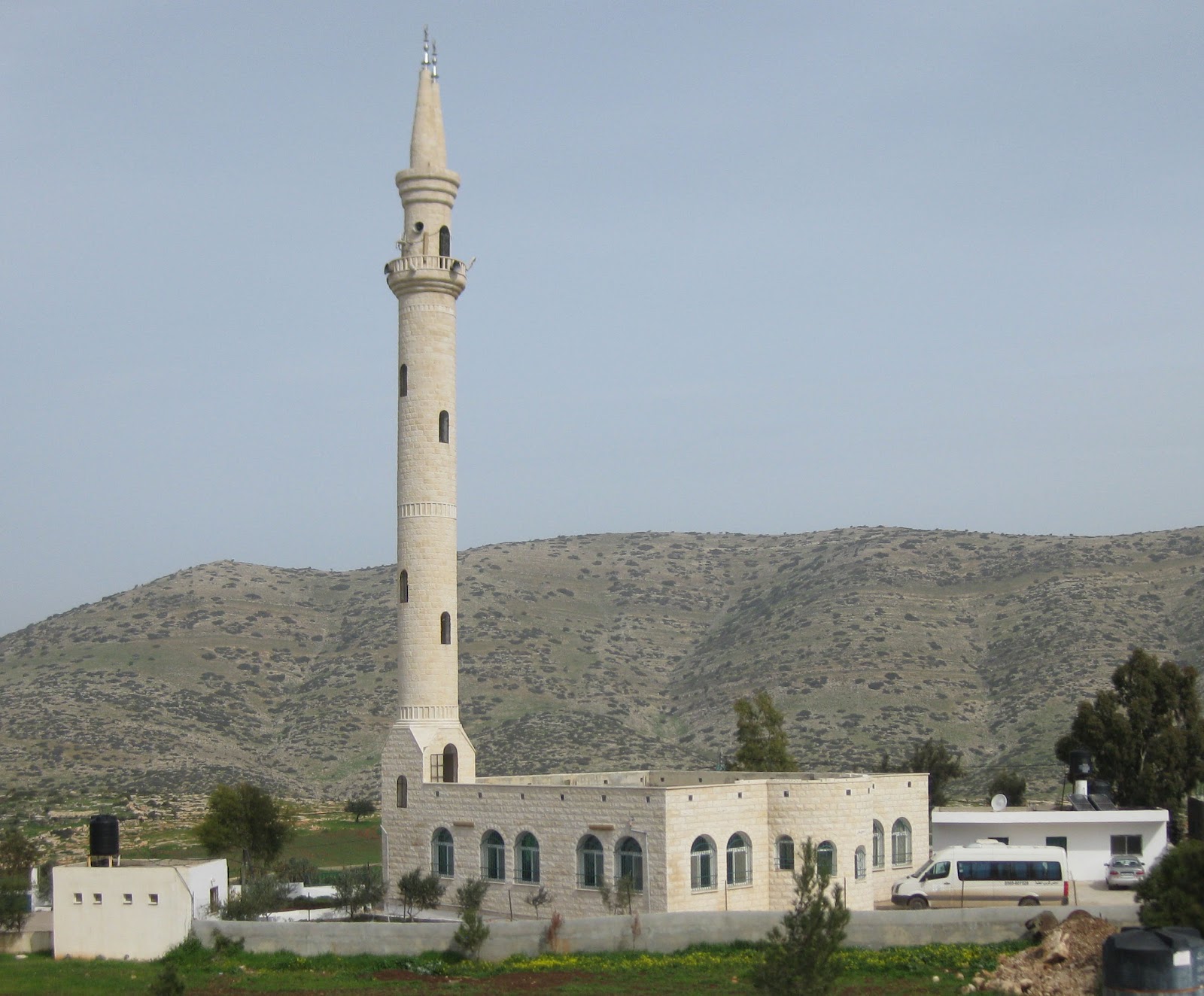
And for the spiritual needs of the community Haj Sami Sadeq built in the center of the village a new mosque.


Salaam hon?

Al-Aqaba still remains under occupation.  This tranquill village, where grandparents love their grandchildren and where civic leaders place education as the highest priority, still lives under a system that strips away human dignity.  This is occupation.

Al-Aqaba may be located in the West Bank of Palestine, but it is in Area C, still fully under Israeli control. 

The first stage of the Oslo Peace accords divided up the West Bank into three zones-- the peace process never advanced beyond that first stage as Israeli settlements created new facts on the ground.


Area A -- the light brown color designates the 8 % of the West Bank under full Palestinian rule, mostly eight separate urban area.


Area B -- the green areas make up about 30 % of the West Bank governed jointly by Israelis and Palestinians.


Area C -- represented by the very light tan color represents 62 % of the West Bank fully under Israeli control, settlements and military zones.

Al-Aqaba falls in Area C, with Israelis making all the macro policy and decisions that affect the micro achievements of the village.

This includes the continuation of military camps in the vicinity.  On June 6, 2006, a young Israeli soldier entered the village mosque at two o'clock in the morning, seemingly with the intent to wait until early morning prayers when he would empty his machine gun into those arriving for prayer.  He had enlisted just two weeks earlier just after coming to Israel from Chicago.  His platoon had been engaged in night military exercises 2.5 kilometers from the village when he slipped away to the mosque.  Fortunately a villager had noticed his arrival and kept the worshippers outside until other soldiers arrived.  What happened next when the soldiers entered is a matter of debate.  The IDF declared the soldier's death as a suicide.  Yet the villagers counted 106 bullets fired inside the mosque, damaging both the building and the body of the dead soldier.  For more details see the Haaretz article. 

Incidents like this remain like a cloud hanging over the community.  Most of the military camps still remain. 

More recently--three weeks ago on January 27 to be exact--the village had two other visitors, agents of the Israeli Civil Administration, bringing demolition notices for seventeen village buildings.  Morgan was on hand that day to film this activity which is now available on YouTube.com 

In some ways this is not surprising.  Currently, over 12,000 Palestinian homes in Area C of the West Bank and in East Jerusalem are under demolition orders.  The official reason:  they have not been granted building permits.  The first demolition orders arrived already in 2004.  Although the village continues to submit through legal representatives a building master plan, although the spacious valley can easily support homes numbering in the thousands, and although they have filed the proper papers for permits, they will likely never receive them because this is Area C.

"I want my village to have the right to issue valid building permits to secure the future of Al Aqaba. With this right, a glaring oversight of the Oslo Accords will be overturned, showing our villagers and the world that peace and justice are achievable through peaceful means." Mayor Haj Sami Sadeq


Now with the latest demolition orders, 97 % of the village is under threat of demolition including the mosque, the domestic homes, the building of economic development, the clinic, and the kindergarten.

The kindergarten is under threat of demolition!

Salaam Hon? 

These are not empty threats.

On Thursday morning, Sep. 15, 2011, without notice, Israeli military bulldozers demolished a home and water cistern in Al Aqaba, leaving 22 people, including 12 children, homeless. The military bulldozers also ripped deep trenches through Peace Street — for the 2nd time.

(photo: Rebuilding Alliance)


Salaam Hon? 

It is easy to understand why the prophets Jeremiah and Ezekiel criticized those who went around exclaming, "Peace, Peace" when there is no peace.

Yet the surprising thing is how the people of al-Aqaba village could convey a sense of peace so much stronger than the peace advertised by the strongest security systems in the world. 

Theirs is a peace that understands how to take in the beauty of God's creation.
Theirs is a peace that knows how to relax over a cup of coffee and enjoy the day.
Theirs is a peace that smiles at the gift of grandchildren.
Theirs is a peace that welcomes the stranger.
Theirs is a peace that builds houses even at the threat of demolition.
Theirs is a peace that invests in children.
Theirs is a peace that understands that the best alternative to machine guns, tanks, bombs is a kindergarten.

Salaam Hon! 

by Fred & Gloria Strickert
http://walkinjerusalem.blogspot.com/