Thursday, January 6, 2011

A time for every matter in the Christmas season

http://walkinJerusalem.blogspot.com/
by Fred & Gloria Strickert

A time for every matter in the Christmas Season. . .

. . . a time to celebrate

in manger square

. . . with longtime Bethlehem friends
. . . a time to pray

Christmas Eve in Bethlehem
Joint Arabic-German-English Language Worship

Bishop Younan's Christmas Sermon
Fear Not!   (Click on Link to read)

Redeemer English Congregation Choir
. . . a time to come together as community

Christmas Day Brunch with 60 + Guests


. . . a time to visit with official greetings

Jerusalem clergy visit the Latin Patriarchy

. . . a time to look serious

President of Israel Peres' Reception
. . . a time to laugh


. . . a time to cry

Memorial Service for 23 Coptic victims of New Year Bombing 

Jerusalem's Coptic Church
on rooftop of Holy Sepulchre

Coptic Priests

Bishop Younan's Words of Condolence
Muslims and Christians together

. . . even when words are not enough


. . . a time to cry some more
December 2 service remembering
52 Iraqi Christians dead from October attack

Jerusalem's Dominican Church of
St. Stephen
(the first Christian Martyr)


Fred & Gloria Strickert

Friday, December 24, 2010

Countdown to Christmas

Fred & Gloria Strickert
http://walkinjerusalem.blogspot.com/


It's December 23rd in Bethlehem and the last touches are being made for Christmas celebrations at Bethlehem's Manger Square.

In between children's Christmas programs, I found time for a short visit to Nativity Church.  If there is a perfect day to visit this historic shrine representing the place of Jesus' birth, it is the day before Christmas Eve.  Our visits this fall were always chaotic with scaffolding occupying center place, repairing a leaking roof, and with record breaking crowds of visitors lining up to see the birth grotto.  Surprise of surprises, on Dec, 23 I walked into a totally empty Nativity church with the scaffolding removed for Christmas and no tourists in sight.  In need of a quiet place away  from the hustle and bustle of the season, I made my way to Jerome's grotto, the cave where the Biblical Scholar from Rome found home when coming to Bethlehem later in his life (I have a personal attachment there).  There were no interuptions because, as I would discover, the caretakers of St Catherines Church had closed the gates and chained off the grottos as they were completing a final church cleaning for tomorrow's midnight mass.  So there is nothing like having the historic grottos to oneself for quiet meditation the day before Christmas Eve.


Later I returned to Nativity Church, still empty of visitors--though this photo was taken a bit later when several men had congregated near the sanctuary just above the nativity grotto.


The most memorable photo I didn't take
If you want to see photos of adorable children from Christmas programs, scroll down to end.  I could not stop myself from taking dozens-- maybe hundreds of snapshots of Palestinian children who embody the hope of Christmases future.

Yet sometimes the most meaningful photo is the one not taken.  The moment seems so sacred, that it would be an act of idolatry to capture such a visual image in a photograph. 

When I returned upstairs to the 1500 year old Nativity church, I found myself sharing that sacred space with four young women, probably in their late teens.  One sat on the empty steps leading up to the sanctuary while another snapped her photo and then a second moved into place.  Then a sudden pause as they spied me standing among the columns on the perimeter-- me, just another visitor, but me wearing my black suit and clerical collar, me, as far as they were concerned, a representative of the religious establishment.  After they offered an "Are we going to be in trouble for this?" look, I responded with a smile and nodded for them to continue.  Quickly, the third young woman took her place sitting on the step, posing for the camera, but looking my way hestitating.  I nodded to continue. Then the fourth followed suit.

I decided to walk over to the photographer.  Four figures froze where they stood, offering a worried look.

"If the four of you like, I can take your photo with all four of you together," I volunteered. 

A sign of relief. Then the four of them took a pose before the altar, the cross, the sacred space recognized through the ages by Christians, while I captured a digital memory for their visit on this Dec. 23, when my visit just happened to intersect with theirs.

Did I mention that the four young women were Muslim?  Dressed in bluejeans and headscarfs they thanked me.  "Merry Christmas!" each one said in turn. 

"And Merry Christmas to you!" I said knowing the importance of the Prophet Isa to their faith and the significance of the virgin birth for them.  Then I added, "You are always welcome here!"

If I were quicker with my wit, I might have said, "There's always room in the inn." or something like that.  But a simple welcome sufficed.  Their smiles and nods of appreciation confirmed for me that this is what Christian witness is all about in the 21st century. 

I had been tempted for a moment to reach into my pocket for my own camera to take one more photo.  Yet I sensed that would have transgressed the boundaries of sacred and profane.  The ancients had this notion that sacred encounters are not to be trivialized by images that were only limiting in scope.  In our brief encounter in the Church of the Nativity, these four young women and I shared a sacred moment--a recognition of God in the other.  A photograph could never capture that.  But memories are another thing.

Leaving Nativity Church, a group of Muslim school girls prepare to enter.  Two young Muslim women pause for the camera.  "We feel welcome here!"
December 18 simulcast
Christmas Lutheran Church in Bethlehem and the National Cathedral in Washington D.C.
                                                                                                                                                                     
Bishop Munib Younan reading Gospel from Luke 2 from Bethlehem.
Member of Bethlehem children's choir below watching Anglican Bishop in Washington D.C.

Jerusalem Christmas Traditions
Living in a multicultural context, the preparations for Christmas are an adventure in a smorgasbord of traditions. 

The Swedish Theological Institute in West Jerusalem is one of the nineteenth-century architectural gems.  Swedish Lutherans come for short courses.  Most Sundays we have visitors from Sweden at our English-language worship.


The Swedish Institute hosted their annual Santa Lucia Day Celebration on December 13.
Santa Lucia Day


On the Saturday before Santa Lucia day, our Danish close friend and neighbor, Susanne Brown, hosted a day of Scandanavian baking, beginning with a festive breakfast.


A Full day of baking.

Delicious and

a Feast for the eyes.


St. Barbara's Day
Among Arab Christians a popular celebration is St. Barbara's Day-- December 4.
Barbara was a third century martyr from Lebanon.


Its's common in Lebanon, and to some degree in Jerusalem, for children to dress up and go to their neighbors asking for sweets.


In Jerusalem it's common to visit the elderly. 


Usually the highlight is to share together a cup of Burbara, a sweet dish of boiled wheat grains covered with pomegranate seeds, almonds, and spices.


Our Arab Pastor, Ibrahim Azar, his wife Nahila, three daughters invited us to their home for the celebrations.

Christmas Programs

Lutheran Kindergarten -- Mount of Olives


Hope Lutheran School in Ramallah

 Of our students in the Ramallah Lutheran School, 80 % are Muslim

Proud Parents!


Merry Christmas

Fred & Gloria Strickert
http://walkinjerusalem.blogspot.com/


Thursday, December 2, 2010

Advent in Jerusalem

by Fred & Gloria Strickert
http://walkinjerusalem.blogspot.com/

Advent is a time for waiting.
We are all waiting for the celebration of Jesus' birth.

On the First Sunday of Advent, our colleague here at Redeemer, Rev. Ibrahim Azar, helps the children of the Arabic congregation light the first candle on the Advent Wreath.

The Redeemer annual Advent Bazaar


Our congregation in Beit Sahour held church at 5:30 in the afternoon on the first Sunday of Advent to encourage more young people to attend. Since we can't get away on Sunday mornings, this was a perfect opportunity to visit with Pastor Imad Haddad and his congregation.

The name Beit Sahour means the "House of Watching" -- a reference to the shepherds staying up all night to keep watch over their flocks.  This is the traditional village of the Christmas shepherds.


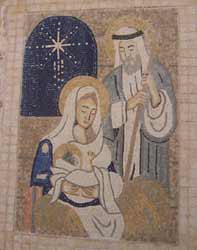
The congregation has a vibrant school with children active in scouts, vocal music, and depka dance.  Several years ago the children made this mosaic of the Holy Family that today greets visitors by the outside door of the church.


A year ago a visiting church group from Sweden was so impressed with the Beit Sahour youth living "Behind the Wall" that they put together an Advent Calendar with Youtube greetings from youth in their two congregations.  Click on this link Fear builds walls, hope builds bridges to see the calendar.

Our English speaking congregation celebrated with a common mid-week soup supper in our home with Advent Devotions.  Tonight we attended a candlelight interfaith service for those killed at Our Lady of Salvation Church in Baghdad.  Here in Jerusalem the Psalm for Advent 1 was "Pray for the Peace of Jerusalem."  We still wait patiently, hopefully.

Jerusalem is also waiting for rain. In the Middle East where water is scarce and rains are seasonal, coming entirely in the late fall and winter months, the beginning of the "rainy season." Today is December 2 and eight months have now passed since the last rainfall.  Usually the olive harvest in October and November is marked by a couple of inches of rain to wash the dust from the trees and to make the olives plump.  Not this year.  With unseasonably warm temperatures in the upper 70s, cisterns are empty and no rain is in site.

One final advent video from our Beit Jala congregation:
Advent at Lutheran Church of the Reformation, Beit Jala

Fred & Gloria Strickert
http://walkinjerusalem.blogspot.com/

Sunday, November 14, 2010

Ecumenical Accompaniers

by Fred & Gloria Strickert
http://walkinjerusalem.blogspot.com/
                                                                              

Living in Jerusalem, we participate in a lot of worship services. Perhaps  most meaningful has been a Handing Over Service for the Ecumenical Accompaniers.  These volunteers come from all over the world for three months at a time.  When one group's time ends, the torch is passed to the next group of 27.


Since the Ecumenical Accompaniment program was started in 2001 there have been 37 groups. 


Group 36
sits in a
circle
around
newly
arrived
group
number 37.


Darkness clouded this land when the accompaniment program began in 2001-- in the midst of the second Intifadah.  Proposals from around the world suggested that UN Peacekeepers were the answer to put a check on violence. Yet politically motivated vetoes have a way of blocking peacemaking plans. So the Jerusalem churches stepped in requesting the World Council of Churches to send peacemakers.  And the EAPPI volunteers have been a light in this difficult situation.


Candles lit by those retiring pass on the light to the newly arrived.


Ecumenical accompaniers belong to all denominations.  As you can see from the photos, a good number are retirement age and may well provide the most effective witness.  The accompaniers are most effective when they are noticed.  So they all wear a tan-colored vest with a yellow dove and the letters EAPPI-- Ecumenical Accompaniment Programme in Palestine and Israel.


Currently we have one ELCA Accompanier.  We are privileged to have as a colleague these three months Donna Matteis from the Southeast Michigan Synod, a companion synod of the Evangelical Lutheran Church in Jordan and the Holy Land.  Donna has visited in the past with companion synod delegations.  This time she committed herself to the frontlines of peace.  Read Donna's blog:
http://mid-eastpeace2010.blogspot.com/


Last week Tuesday, Gloria went with Donna at 5:00 a.m. to the Qalandia Checkpoint where residents have to cross into Jerusalem.  Palestinians begin lining up at 4:00 a.m. in hopes of getting through more quickly to work, school, or the hospital.  These are the lucky few who can get permits, the ones whose reputations have proven them to be no risk to Israel.  Still it is a humiliating and time-consuming ordeal that these Palestinians have to go through two times each day, six days a week, 52 weeks every year.


Ashraf Tannous is the Vicar of our Arabic congregation at Redeemer in Jerusalem.  Here he is last September as he begins his twice-daily two hour commute from his home in Ramallah, what used to be a 15-minute drive.  And Ashraf has a VIP pass. 

We are privileged with our U.S. Passports to drive through with somewhat limited questioning, still usually a wait of a half hour.
Donna has a sophisticated counter, that keeps track of how many individuals are allowed through the maze of "cattle stalls" each hour, how many men, women, and children--every possible category.  This way they know when soldiers are unnecessarily delaying the process-- whether by orders from above, or by personal whim.  Reports are filed with the authorites.  Sometimes the accompanier makes a phone call to the authorities to ask why. 

On Tuesday, the humanitarian lane was closed for no reason at all.  People were turned back, right and left.  A woman with a permit to bring her child for dialysis at August Victoria Hospital was denied passage without explanation.  She came to Donna in tears and Donna filed her report, while the soldier stood by laughing.  The mission of the ecumenical accompanier can be frustrating, but heed the words of Paul's epistle lesson this morning, "Do not grow weary in doing what is right!"  Sometimes there are even minor victories.  This morning at church Donna reported that the humanitarian lane was once again open--thanks to those 5:00 a.m. visits to Qalandia to accompany Palestinians through this daily ordeal.
So you'd like to learn more about how you can be an Ecumenical Accompanier?
See:  http://www.eappi.org/
or     http://www.eappi-us.org/
Fred & Gloria Strickert
http://walkinjerusalem.blogspot.com/

Monday, October 25, 2010

Olive Harvest

by Fred & Gloria Strickert
Http://walkinjerusalem.blogspot.com/

If your house is located on the top of the Mount of Olives, eventually you will find yourself picking olives. So yesterday we participated in the olive harvest.

The Lutheran World Federation Compound has 800 olive trees that are harvested each October and November to raise money for "The Poor Fund" to assist Palestinian families who cannot pay their medical bills at Augusta Victoria Hospital.  All the olive picking is carried out by volunteers:  Classes from various schools, tourist groups, and individuals who are willing to get a little dirty for a good cause.  Our congregation spent all of Saturday picking olives.  Today a group from the American Consulate is here.  Next week Swedish and Finnish groups will lend a hand. 


Two recent college grads supervise the project.  Brit is here serving a two-year internship with the LWF and organizes groups for the olive harvest.  Warren has come for three months this fall to prepare the grove, to trim the trees, and to haul the olives to the olive press, all before he heads off to grad school next January.  From the photo below on the right, you can see from the smiles of Brit and Warren how satisfying it is to take on such a venture.
As you can see from pictures below, the process involves laying out large tarps underneath the branches and then pulling the olives off the tree with a plastic rake.  Often six people are needed per tree, each one planting feet in one spot and allowing the olives to fall to the ground.


When all the olives are picked from a tree, the twigs and leaves are removed.  Below Ann, Emily, and Jill are cleaning the olives.  Then the olives are stored in burlap bags.  Here are the 17 bags of olives our group filled from 39 trees.  A good day's work.

On Tuesday, we'll drive the olives to the Latrun Monastery, some twenty miles west of here, where the olives will be pressed into oil and poured into bottles especially made by a glass maker in Hebron.  Up until last year, the olives were pressed just five miles away in Beit Jala.  However, the Israeli government has added an 18 % Value Added Tax, since the pessing takes place in the West Bank.  So it's one of those tough decisions:  Support the Palestinian economy or keep that 18 % for those in need of medical care?
If you would like to donate to the AVH poor fund and receive a gift of Mount of Olives olive oil, see http://lwfjerusalem.org/projects/olive-oil/

Congregation Group Photo


Olives are a staple for every Palestinian family.  Trees normally survive for centuries, so they are passed down from one generation to another like family heirlooms.  They are planted, cultivated, watered, pruned, and cared for as if they were a member of the family.  The olive provides food, as also oil for cooking, medicinal purposes, and fuel for lamps. The wood and pits are used for fuel.  No wonder that the olive branch is a symbol for peace.  No wonder in earlier years, olive oil was poured over the head in blessing.

Ten million olive trees dot the terraced hillsides of the West Bank, making up 45 % of cultivated land.  The annual income for processed olive oil alone is over one hundred million dollars.  The future of the Palestinian economy is tied directly to those twisted roots seeking moisture in the shallow, rocky soil.  The harvest is nothing but labor intensive.  Once Palestinian farmers passed the time with songs about olive trees and celebrated as families joined hands in this common task.

Yet the political situation has turned olive harvest songs to a minor chord.  Bull dozers do not hestitate to uproot these family heirlooms when it is in the occupiers' interest or convenience.  In other cases, West Bank Palestinians frequently find themselves harrassed by settlers when they attempt to harvest their own trees or they find the trees already picked under the cover of night.  Occasionally shots are fired.  The newspapers report plenty of episodes, but enforcement of law is not a priority when settlers are involved.  An article in this mornings paper noted that there have been 27 official complaints to the border police already this season.  Yet it noted that Palestinians no longer bother to file complaintes since there is rarely any follow-up.  Settlers have their own standard of law and order. 

So it was that eighty-year old Rasmia Awase found her forty trees near Luban a-Shariqa chopped down near the the stumps several days ago.  She had planted them herself, and cared for them throughout her lifetime, hoping to leave them as a legacy for her grandchildren.  Now she can only water the stumps with her tears.

Rabbis for Human Rights reports that six hundred trees near another settlement in the south were picked clean before the Palestinian owners could get to their fields.

And so the story goes.  One newspaper writer suggested that the settlers were angry at the peace talks and the settlement expansion moratorium, so they wanted to send a lesson-- no different than the school set on fire near Nablus or the mosque burnt near Bethlehem, with graffiti signed by settler vandals.

The olive branch is supposed to be a symbol of peace.  Here it has been turned into a token of racial hatred and extremism by people claiming to act in the name of God.


Donna, pictured above, is a fellow Lutheran from the Southeast Michigan Synod-ELCA (wearing her distinctive EAPPI vest) who is one of 27 World Council of Churches "Ecumenical Accompaniers" spending three months here this fall, walking with Palestinians, often helping with the West Bank harvest as a matter of justice and security for Palestinians.  Donna and others will harvest a few olives in the process.  However, her presence will provide hope for Palestinian farmers feeling harrassed by those nearby and disheartened by a world with no resolve to bring about peace.  Her presence may even deter a few acts of vandalism, and her witness may even bring some criminals to justice.  Donna is here for the olive harvest out of her deep faith.

Bishop Burnside from Wisconsin also arrived this week with a group who will spend several days in accompaniment through the olive harvest.  Similarly a Sabeel group picked olives last week in the northern West Bank.  Oxfam and Rabbis for Human Rights are also active in safeguarding this ritual followed for thousands of years in these rugged hills.

Our prayer request is simple.
Pray for a safe and productive olive harvest.
Pray that the olive branch once more becomes a sign of peace.

Fred & Gloria Strickert

Wednesday, October 6, 2010

Our Servant Congregation

From Fred & Gloria Strickert      http://walkinjerusalem.blogspot.com/

Early in September we shared with you photos of our installation service at the Lutheran Church of the Redeemer in old city Jerusalem.  So you had a glimpse of our congregation: Individuals and families from all over the world who are serving the church in various capacities. 

Our Sunday worship can vary in size depending on visiting tour groups.  We have a core group of about 50 persons from many denominations, including a large number of young adults who are here in various volunteer capacities, serving from three months to a year or longer.  A few Sundays ago we commissioned for service 14 individuals who had newly arrived and hosted them at our house for Sunday brunch. The following photos are but a sampling of these dedicated servants.

 
                                 Clayton (Sabeel)   Emily (ELCJHL Schools)    
               Margriet (Sabeel)                                                 Brit (LWF)


                                                  Sunday Brunch at Our House
  
Mike (Hebrew Univ.); Martin & Suzanne (ELCA);  Ian (Sabeel); Katie (Edward Said School of Music)


                                David, Janelle, Luke (YAGMs)
    Brian (World Vision)                Ingrid (Mennonite Central Committee)

ELCA Young Adults in Global Mission
David (Ramallah); Janelle  (Beit Sahour); Luke  (Beit Jala)
Trena  (Beit Sahour); Sarah (Bethlehem); Abby  (Jerusalem)


.On Wednesday nights, our congregation hosts an evening of volleyball and potluck fellowship at our neighbors the Brown's house here on the Mount of Olives.

Ministry is a real joy in such a setting.  There is never a need to motivate the congregation for service.  That's why they are here.  Yet in a high-stress, politicized, and challenging climate our members need to come together for a respite, community, and spiritual nourishment.  And many of them operating on a shoestring budget appreciate the fellowship of a home-cooked meal.  We provide a bit of stability in an ever-changing environment

Fred & Gloria Strickert  http://walkinjerusalem.blogspot.com/