Thursday, February 16, 2012

Salaam Hon!

http://walkinjerusalem.blogspot.com/
by Fred & Gloria Strickert


"So what do you think of our village?" the elderly couple asked.
"Salaam hon," we replied.  "It's peaceful!"  or more accurately "Peace is here."


What can be more peaceful than a village where its elders gather to discuss business around a tree?

What can be more peaceful than a village nestled between the hills with the fertile fields turned green by the winter rains?

What can be more peaceful than a place where people want nothing more than for their children's dreams to be fulfilled.


This is a blog about the village of al-Aqaba in the far northeast corner of the West Bank (not to be confused with Jordan's seaport Aqaba on the Red Sea or another Palestinian village Aqraba southeast of Nablus).

For us al-Aqaba provided a welcome respite from the noise and clammer of the city, the fast-paced and stressful life of Jerusalem.  The pastoral setting, the unseasonably warm sunny day, and the simple life-style of al-Aqaba can be deceiving.  Peace here?   You have to be kidding.  When you hear the story of the last forty years or so (and we'll come to that later), you'll understand why many would hesitate to use the words peace and al-Aqaba in the same sentence.  You'll understand why residents of al-Aqaba could remain pessimistic about the future.  You'll understand why the residents of this small village would have every reason to be suspicious of visitors from the outside.  Instead the welcome mat was rolled out for us.  Ahlan wa Sahlan!  They would teach us what it is that makes for peace.

Why would this modern-day Abraham and Sarah not be suspicious also of us arriving at their "tent" unexpected?  Instead they insisted that we sit down and rest a bit and share a cup of tea. "Try some of our fresh picked lettuce."   "Now you need some coffee."  We laughed watching their two grandsons play on a make-shift swing hanging from a shade tree.  That was a topic we both understood, "And how many children and grandchildren do you have?"  They more than doubled us.  And then two more came walking home from school with their backpacks and a hunger for an after-school snack before starting their homework.  Salaam hon!  Peace is indeed here!

For our visit to al-Aqaba we were accompanying one of our congregation members, Morgan, whose great-grandfather, as it turns out, was my seminary homiletics professor.  We often describe our congregation as a servant-congregation--made up of a significant number of young volunteers who are here to serve for anywhere from three months to a year.  And on any given Sunday while we are engaged in Word and Sacrament in our Redeemer chapel, the majority of them are embodying Christ's love in the communities they serve in Jerusalem and throughout the West Bank from Hebron in the South to a place like al-Aqaba in the north.  What is amazing is how they manage to get to church as often as they do, like Kathy from the Christian Peacemaker Team in Hebron, making connections via three or four buses, passing checkpoints, and various hurdles just for the opportunity of being in community.

So on this past Sunday morning, when Morgan managed the long trek from al-Aqaba to Jerusalem for our Sunday worship, she mentioned that she had to stay in Jerusalem for an afternoon meeting.  Gloria and I looked at each other and were quick to volunteer to drive her back in exchange for a place to stay over night and a tour of the village and a chance to learn about her work there.

Morgan and the small guest house she manages for the village of al-Aqaba.   
Morgan learned about al-Aqaba through an online search of Palestinian towns and villages where she might be able to contribute her talents to the life of people.  An American-based organization called Rebuilding Alliance (click to read more) had assisted in building a school there and was looking for someone to teach English. In addition, Morgan assists mayor Haj Sami Sadeq in community development projects with a goal of bringing former al-Aqaba residents back to their homes as well as outsiders to visit this location off the beaten path. 

The message of welcome is the first thing visitors see.

Today there are only 300 villagers who have remained steadfast, a drastic change from the mid-sixties when over a thousand persons enjoyed the idyllic setting.  Then came the 1967 war and occupation.
Unlike the rest of the Israeli Occupied West Bank where expanding settlements are the problem for Palestinian villagers, The Israeli Defense Force decided to use this part of Palestinian land for military camps.  In the map below, al-Aqaba is in the center.  Further to the east large military camps are designated by the reddish brown color.  Eight smaller camps totally surround the village.

These include the elite ( = ruthless) Golani Brigade who carry out regular training exercises in these hills and, at times, within the village itself.  Yes, you read that last sentence correctly.  A military brigade that practices within an occupied village, among real live human beings trying to carry out their daily lives.

The first "accident" occurred in 1971, when the then sixteen-year-old Sami Sadeq (now mayor) was helping his parents in the fields and was shot with three bullets.  An IDF ambulance took him to an Israeli hospital in Afula where they were able to remove two bullets from his spine, leaving him paralyzed from the waste down.  The third bullet remains lodged to this day next to his heart. 

The amazing part of the story was that Sami did not give up.  He chose to remain to work through the system to help his relatives stay steadfast on the land.  While in the hospital during those months following the shooting, he spent all his energies learning Hebrew to aid in communication.


Over the years another eight villagers were killed and another fifty were wounded by the military exercises.  Perhaps the most bizarre story that we were told was that the IDF practiced night raids in the village itself to prepare for the 1982 invasion of Lebanon, because the village was similar in structure to many in Southern Lebanon.  Not surprisingly, three-fourths of the residents moved out to  the neighboring village of Tayasir or to the city of Tubas to the West.  There was no compensation.  They simply lost everything and had to start over again.  How could they dream of peace under these conditions?

That evening we spent in al-Aqaba seemed so peaceful, so quiet.  The sleep was so restful until 3:00 in the morning when I awoke to the sound of gunfire.  Another practice round for night time raids.   I wondered what must be going through Sami's mind or the grandparents of the four children we met.  Salaam Hon? 

Yet Sami has remained steadfast.  And there have been small victories.

After years of legal arguments and numerous appeals, the Israeli High Court in 2001 finally ruled that the military camps adjacent to the village on the west must be removed and that the IDF could no longer use the village for military exercises.  The small hill in the photo below (just beyond the houses) was the site of one of those camps.


Villagers feeling relieved and perhaps a bit optimistic, began rebuilding with simple homes that would be more than adequate lifestyles.   They planted gardens and invited former residents to return.  A morning walk around the village showed us signs of progress, houses just completed and foundations of others being layed.  Salaam hon?

Mayor Haj Sami Sadek felt they needed more than just new homes.  If they were really thinking about the future, the key would be a kindergarten.  Here is where Rebuilding Alliance entered the picture, offering educational expertise and funding to complete the building in 2004.  Click to see a Youtube video about the al-Aqaba kindergarten.   It was a brilliant idea.  There were no kindergartens in the villages located to the west.  So every day school buses and private vehicles bring children to al-Aqaba, many of them families originally from the village.


Today 130 students are enrolled in the kindergarten.  As we toured the classrooms where the children were engaged in singing and in group play, the mayor was outside supervising another building project, a roofed playground for the children to play outside on rainy winter days. Nearby there is an elementary school.

The positive court ruling and the progress taking place in the village paved the way for foreign governments to get involved, including funding from USAid for the paving of a road. The Japanese Embassy erected a new water tank and provided a truck (see photo of truck next to the meeting tree above) to bring water from a neighboring village  (the old water supply had been destroyed by the IDF), the British Embassy paid for a clinic, and the Catholic Church is considering offering a plot of land for a birthing center.


Japan, Norway, and Belgium provided funds to build additional floors on top of the kindergarten for economic development projects including a tea-bag factory and a sewing coop that exports dresses to Canada and the USA, where young women and men can find employment, and where mothers can coordinate their hours  while the children are in school. 

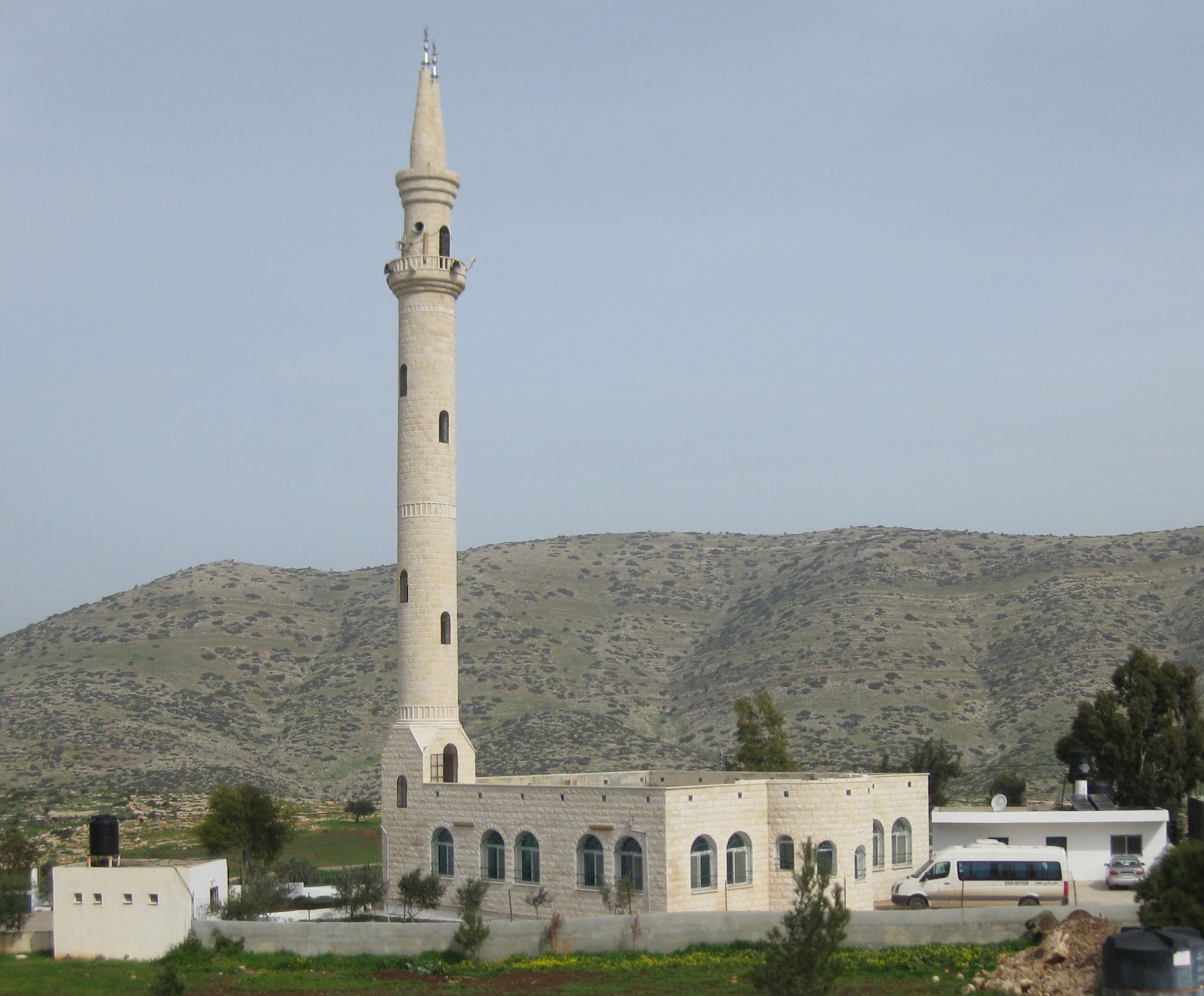
And for the spiritual needs of the community Haj Sami Sadeq built in the center of the village a new mosque.


Salaam hon?

Al-Aqaba still remains under occupation.  This tranquill village, where grandparents love their grandchildren and where civic leaders place education as the highest priority, still lives under a system that strips away human dignity.  This is occupation.

Al-Aqaba may be located in the West Bank of Palestine, but it is in Area C, still fully under Israeli control. 

The first stage of the Oslo Peace accords divided up the West Bank into three zones-- the peace process never advanced beyond that first stage as Israeli settlements created new facts on the ground.


Area A -- the light brown color designates the 8 % of the West Bank under full Palestinian rule, mostly eight separate urban area.


Area B -- the green areas make up about 30 % of the West Bank governed jointly by Israelis and Palestinians.


Area C -- represented by the very light tan color represents 62 % of the West Bank fully under Israeli control, settlements and military zones.

Al-Aqaba falls in Area C, with Israelis making all the macro policy and decisions that affect the micro achievements of the village.

This includes the continuation of military camps in the vicinity.  On June 6, 2006, a young Israeli soldier entered the village mosque at two o'clock in the morning, seemingly with the intent to wait until early morning prayers when he would empty his machine gun into those arriving for prayer.  He had enlisted just two weeks earlier just after coming to Israel from Chicago.  His platoon had been engaged in night military exercises 2.5 kilometers from the village when he slipped away to the mosque.  Fortunately a villager had noticed his arrival and kept the worshippers outside until other soldiers arrived.  What happened next when the soldiers entered is a matter of debate.  The IDF declared the soldier's death as a suicide.  Yet the villagers counted 106 bullets fired inside the mosque, damaging both the building and the body of the dead soldier.  For more details see the Haaretz article

Incidents like this remain like a cloud hanging over the community.  Most of the military camps still remain. 

More recently--three weeks ago on January 27 to be exact--the village had two other visitors, agents of the Israeli Civil Administration, bringing demolition notices for seventeen village buildings.  Morgan was on hand that day to film this activity which is now available on YouTube.com 

In some ways this is not surprising.  Currently, over 12,000 Palestinian homes in Area C of the West Bank and in East Jerusalem are under demolition orders.  The official reason:  they have not been granted building permits.  The first demolition orders arrived already in 2004.  Although the village continues to submit through legal representatives a building master plan, although the spacious valley can easily support homes numbering in the thousands, and although they have filed the proper papers for permits, they will likely never receive them because this is Area C.

"I want my village to have the right to issue valid building permits to secure the future of Al Aqaba. With this right, a glaring oversight of the Oslo Accords will be overturned, showing our villagers and the world that peace and justice are achievable through peaceful means." Mayor Haj Sami Sadeq


Now with the latest demolition orders, 97 % of the village is under threat of demolition including the mosque, the domestic homes, the building of economic development, the clinic, and the kindergarten.

The kindergarten is under threat of demolition!

Salaam Hon? 

These are not empty threats.

On Thursday morning, Sep. 15, 2011, without notice, Israeli military bulldozers demolished a home and water cistern in Al Aqaba, leaving 22 people, including 12 children, homeless. The military bulldozers also ripped deep trenches through Peace Street — for the 2nd time.

(photo: Rebuilding Alliance)


Salaam Hon? 

It is easy to understand why the prophets Jeremiah and Ezekiel criticized those who went around exclaming, "Peace, Peace" when there is no peace.

Yet the surprising thing is how the people of al-Aqaba village could convey a sense of peace so much stronger than the peace advertised by the strongest security systems in the world. 

Theirs is a peace that understands how to take in the beauty of God's creation.
Theirs is a peace that knows how to relax over a cup of coffee and enjoy the day.
Theirs is a peace that smiles at the gift of grandchildren.
Theirs is a peace that welcomes the stranger.
Theirs is a peace that builds houses even at the threat of demolition.
Theirs is a peace that invests in children.
Theirs is a peace that understands that the best alternative to machine guns, tanks, bombs is a kindergarten.

Salaam Hon! 

by Fred & Gloria Strickert
http://walkinjerusalem.blogspot.com/

Wednesday, February 1, 2012

Prayer for Christian Unity 2012

http://walkinjerusalem.blogspot.com/
by Fred & Gloria Strickert

Peter & Andrew embrace: the model of unity

Week of Prayer for Christian Unity
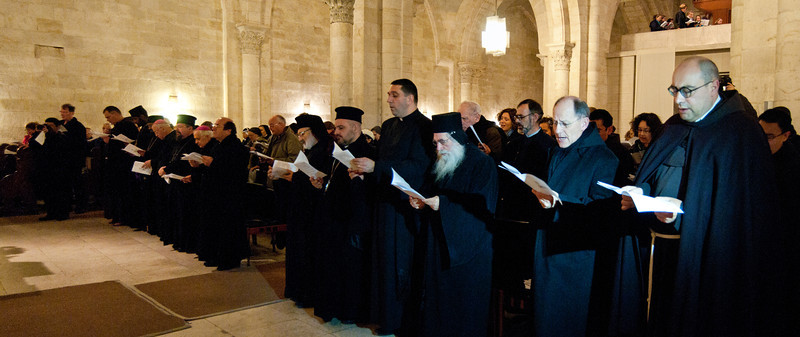
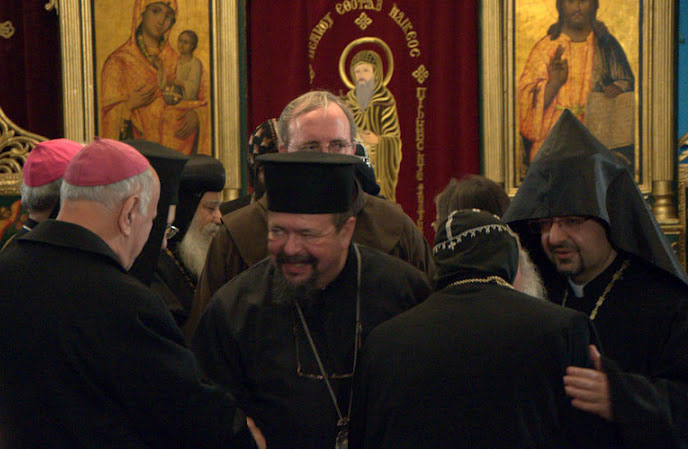
One of the highlights of life in Jerusalem is the experience in late January, in the cold of winter under rainy skies, of warm Christian fellowship and prayer with Christians from the widest expanse of liturgical traditions bringing to reality what we confess in the creed each Sunday of "one holy catholic and apostolic church."  We share with you a few visual memories of this week.

Saturday
Church of the Holy Sepul- chre   Greek Orthodox Clergy
Sunday
Anglican Cathedral of St. George
 
Theme: We will all be changed by the Victory of Jesus Christ (1 Cor. 15)

                  Monday
Armenian Cathedral of St. James


Tuesday
The Lutheran Church of the Redeemer

Bishop Younan's Sermon
Read it here


The Prayer for Christian Unity


United in Christ who gives us the victory, let us pray to God:

For the Church, the Body of Christ, that we might truly live the unity we receive through the Holy Spirit.
Unite us around the cross of Jesus.

For the leaders of our churches that they may be faithful to the unity to which all Christians are called and that they may show humility and meekness through the example of Christ.
Unite us around the cross of Jesus.

For the nations of the world, that all may live in peace with one another and promote justice for all and that political leaders may seek the welfare of all and not follow their own interests.
Unite us around the cross of Jesus.

For the people of our society, that we may respect the human rights and dignity of all and that we may be transformed to live as caring neighbors.
Unite us around the cross of Jesus.

For the sick and suffering, that we may accompany them in their struggles and that they may be transformed by your healing presence.
Unite us around the cross of Jesus.

For our relationships with Jews and Muslims, that we may find courage to tear down walls of indifference, fear, and hatred as we show respect in a spirit humility.
Unite us around the cross of Jesus.

For the common witness of the Church in the Holy Land as it carries the cross of Jesus in the world today looking forward in hope to the final victory of our Lord Jesus Christ.
Lord, stand in our midst and grant us unity and peace. Amen.


Wednesday
Latin Patriarchate Church

Thursday
Upper Room


Friday
Ethiopian Orthodox Church


Saturday
St. Anthony's Coptic Church


Sunday
Greek Catholic Church


The bread of the Agape Feast dipped into wine is a foretaste of the unity to come.

For Jerusalem's Week of Prayer for Christian Unity 2011, see archives "February 2011"
Photo credits: Elly McHan, ELCJHL and Marie Armelle

By Fred & Gloria Strickert


Tuesday, January 17, 2012

My Favorite Place

http://walkinjerusalem.blogspot.com/
by Fred & Gloria Strickert

The Lutheran Church of the Redeemer made the New York Times this weekend, with the description “my favorite church in Jerusalem.”

The author. Matt Gross, for four years wrote a regular column for the Times, called The Frugal Traveler having visited nearly two hundred countries around the globe. So he’s certainly a person with a lot of travel experience, and he’s likely set foot into more churches, synagogues, mosques, and temples world-wide than most globe trotters—after all he’s the Frugal traveler. And here in Jerusalem (a city know by the proliferation of religious places), he refers to Redeemer as his favorite.

It’s a nice little travelogue and you can click on it here: Lost in Jerusalem (aka My favorite place).

An interesting aspect of this story that Gross shares with the reader in the first paragraphs is that he considers himself a “deeply’” secular Jew from Brooklyn who never wanted to visit Israel. Yet last December, at the encouragement of a friend, he made his first trip, all the while thinking of himself as the “lone unbeliever” in a sea of religious people.

Something about this church affected him so that he returned several times including a Sunday morning worship service. And so his final verdict: my favorite place in Jerusalem.

For those of us who consider Redeemer “home,” this it quite the compliment.

It lead us to reflect a bit about the many visitors who come our way, those who show up on a single Sunday to attend worship and those who drop by during the week to say a prayer, to gaze at architectural beauty, or to pause for a moment of silence making connections between these myriads of physical stones and that which continues to remain unseen.

The first thing that strikes us is, as realtors often say, location, location, location.


Celebration of Holy Fire at Orthodox Easter at Tomb of Jesus.


In the photo we use as the header for this website, the two domes just to the west of Redeemer are over ancient Golgotha and the tomb.  Sometimes we have to pinch ourselves as a reminder that here in the heart of old city Jerusalem, just a stone’s throw away of the Church of the Holy Sepulcher, the empty tomb, and the Via Dolorosa, stands a magnificent Lutheran Church. Even among Lutheran visitors, probably only a third are cognizant of this fact before they come, another third are pleasantly surprised, and another third pass by our doors without even realizing who we are.

Yet it is because of the location that so many folks stumble upon us unexpectedly—people from all walks of life, from all corners of the earth, and from every faith expression whether counting themselves among the faithful or the skeptical. And in contrast to the gathering of crowds in the nearby well-known ancient churches and the busy streets and markets, Redeemer is not on the itinerary of most tour guides. As a result, it is a comparatively quiet place, attractive for those who want a moment alone.


A second observation from our time here is that Redeemer is appealing to many because of its simplicity. Gross describes the main sanctuary as both “elegant and spare” with tall pillars and graceful curves. The main sanctuary was constructed in 1898 under the direction of Kaiser Wilhelm and German architects in a Neo-Romanesque style and the ubiquitous Jerusalem limestone. Those cold grey stones are windows to a vastness of thoughts and ideas. Most visitors don’t realize it, but the walls were once covered in paint, but in restorations following the shelling in the 1967 war, the color was all stripped away except for a small circular Christus Rex in the upper apse.

Redeemer offers regular organ recitals and concerts for string ensembles on Saturday nights.  By far the largest number of attendees are Israelis who venture into the old city for this blend of music and architecture.

It is very common for the groups that I meet to express an appreciation for this lack of decoration. The ornate styles of the Middle East are something that westerners grow to appreciate only over time. The simple cold stone has a calming affect and is inducive to reflection.

The same goes for the worship space of the English Congregation, our smaller St. John’s Chapel restored from the 12th century hospital refectory. The less-than-perfect rugged stone work remains bare, yet hinting of an ancient archway here or the beginning of a stairway there, and a blocked passage-way in the wall behind the altar. Such architecture often transports one’s thoughts to earlier times and that great cloud of witnesses that spans the centuries.


It is not unusual to find a solitary figure sitting in quiet meditation in either of our places of worship.  The doors are open throughout the week. Most people come and go, no questions asked.  Our purpose is not to intrude, to destroy a special moment.

But sometimes someone lingers, like the Hebrew University student last February who missed her worshipping community back home, and who subsequently returned again and again. Sometimes one of our doormen offers an invitation or provides a bulletin with prayers and readings or further information. I had to smile last week when our Muslim custodian, Abu Muhammad, brought one such visitor to my office, “This is my pastor.” But often the visitors come quietly in wonder and anticipation and leave quietly with heads bowed.

On Sunday mornings we have English-language services at 9:00 in the 12th-century chapel, while Arabic service are going on next door in the large sanctuary. Our goals are to be welcoming congregations. One of the exciting things about Sundays mornings is that we never know what to expect or whom to expect. We have our core group of regular members, some here on work, some for study, and many in volunteer capacities. Coming to Jerusalem on temporary assignment they keep their church membership back home, just as we continue to belong to our home congregation in Waverly, Iowa. We use Evangelical Lutheran Worship in our services and we have Lutheran in our name. Yet we speak of ourselves also as International and Ecumenical with arms open to welcome all.


A year ago with only one child in our Sunday School program, we decided to make children’s ministry a priority, and quickly discovered that this is a critical need for expatriate personnel with families. Through word of mouth we now count seventeen children among our children bringing new life and excitement to all. When we stepped back to evaluate what was taking place, the surprise that only one of these families has a Lutheran background. All are welcome. This is the nature of ministry in Jerusalem. We have fourteen ELCA Lutherans, and Lutherans from Norway, Sweden, and Finland actively involved in the life of the congregation, yet our church council at the end of the year included a member of the Free Church tradition in the States, a Mennonite, an English Baptist, a French Protestant, and just one Lutheran. We’re all here because we need our faith community.

The majority of our worshippers on any given Sunday are one-time visitors, pilgrims, tourists, delegations, sometimes coming alone, and sometimes in larger groups. Occasionally we know in advance about a group. But most often it is a serendipitous surprise. At the end of the service we take time for introductions, no matter how long it takes. They too come from all over the world, and likely from every denomination. The last two Sundays we’ve had kipa-wearing rabbis in the congregation, coming with Christian colleagues on interfaith tours—going together to synagogue on Saturday and then coming together to our service on Sunday. All are welcome.

The Frugal Traveler mentioned in his travelogue that his several visits to the solitary quiet of Redeemer  lured him back for a Sunday service, when the Arab congregation was gathered. He was impressed with the greeting at the door, “All the languages are in God’s light.” It didn’t matter that the woman behind him sang in a reedy voice, or that the kids were restless, or that the organist hit a few errant notes. This was his favorite place.

A welcoming church in Jerusalem is no different than welcoming churches in the States. The surprising line in this article was not so much that he mentioned Redeemer in glowing terms, but that he compared worship at Redeemer to an earlier experience visiting a church in Decorah, Iowa.  That's Decorah, as in the small town just up the road a bit from our home.  Naturally we wondered if perchance he had been a student at Luther College. But after researching his earlier blogs, we learned that The Frugal Traveler had just been driving across the midwest on a road trip for another column. There, stopping at a random eating establishment, he struck up a conversation with the owners who ended up inviting him into their home for three days, and also to attend church on Sunday morning. 

It’s the same with churches everywhere, Decorah, Iowa or Jerusalem.  All are welcome.

by Fred & Gloria Strickert
http://walkinjerusalem.blogspot.com/

Friday, January 6, 2012

Seeing the Baby Jesus

http://walkinjerusalem.blogspot.com/
by Fred & Gloria Strickert

We first saw Jesus a baby in a crib.
This same Lord Jesus today has come
to live in our world;
he is present in our neighbors we see,
our Jesus is with us, and ever sets us free.
      "All Earth is Hopeful" verse 4, ELW 266

Christmas is best understood through the eyes of children.  So for our Christmas Day worship at Redeemer the children themselves read the Christmas Gospel from the Spark Story Bible.

With our own four grand- daughters -- ages two and a half to ten -- here sharing Christmas week (and in this photo posing at the eighth-century Islamic Hisham Palace in Jericho) we had the benefit of their observations, their insights, their interpetations, and their honesty and candor to help us see things a bit differently than we normally see them.


Along with our granddaughters, we of course enjoyed the company of our son, two daughters, and two sons-in-law, experiencing Christmas in Jerusalem and Bethlehem. 
It was time for fun and celebration, for sharing and catching up on things, for a little site-seeing, and for just being together-- a real blessing for us all.  During our drives, we found time to reflect upon the words spoken by the young.

"I want to see the baby Jesus," two-and-a-half year-old Lilly reminded us upon her arrival late Sunday afternoon.  Their travel schedule had placed them on an airplane through Christmas Eve and most of Christmas Day.  So they had missed our Saturday visit to Bethlehem for Christmas Eve worship, for browsing among the crowds in Manger Square, and for watching the afternoon parade of the Latin Patriarch, dignitaries, and local Scouts drum and bugel corps including the Syrian Orthodox bagpipe group.  So what were Lilly's priorities?  "I want to see the Baby Jesus?"  "We'll have to wait til later in the week when we'll take you to Bethlehem," Fred responded.  "And what if that doesn't satisfy her?"  Gloria asked.  "We'll just have to see."

We had several stops in our itinerary at the beginning of the week before we would travel to Bethlehem, including a day in the desert east of Jerusalem, with a long hike and visit to St. George's Monastery in Wadi Qelt.

"I hiked all this way, and all I saw was four dead guys and a treasure chest."

This was five-year old Izzy's out-of-breath appraisal when arriving once again up the hill where we had parked the cars across the gorge from the monastery.


One has to grow in to an appreciation of the orthodox style of art with dark painted icons and ornate decorations.  It is not too difficult for a child to turn one's focus to the skeletons of former monks and perhaps to remind us of Luke's Easter angel, "Why do you seek the living among the dead?"

Perhaps Lilly's quest for the baby Jesus would better take place elsewhere.
We first saw Jesus a baby in a crib.
This same Lord Jesus today has come to live in our world;
he is present in our neighbors we see.

"I rode a camel!"
exclaimed Lilly.

Then a little later she reminded us, "I want to see the baby Jesus!"

So, yes, we'll be visiting Bethlehem tomorrow!
But would Bethlehem fill Lilly's expectations?


We learned at the monastery that one of their four monks was lying in a hospital bed with a gash over his eye from the fight the previous day at Nativity Church.  We probably don't have to explain.

 Thanks to Youtube, video of priests fighting with mops and brooms had circled the globe--an embarrassment to the local church.  "That's what you can expect from Palestinians," I overheard an Israeli guide telling his group back in Jerusalem.  Of course, what is not usually said is that the priests involved are not Palestinians but expatriates, both the hierarchy of the Greek Orthodox church and Armenian students who have come from abroad to study in the local seminaries-- and so a great divide separating them from the local Palestinian Christian membership, not a theology of accompaniment.  (See Munther Isaac's article on Sojourner's website.)  So every year when the Greek Orthodox and Armenians have their annual cleaning day before Orthodox Christmas, it seems that arguments and fights break out, not the kind of thing the baby Jesus would approve of in the place of his birth.

So what were we to expect in Bethlehem?
Would Lilly find the baby Jesus?

"I think they're playing tag," announced seven-year old Emma in the backseat as we were driving through the streets of East Jerusalem the next day on our way to Bethehem.  We had come across a group of Palestinian youths running down the side walk as fast as their legs would carry them, being chased by green-uniformed Israeli soldiers with their rifles drawn.  Still in the age of innocense Emma had sized things up from her realm of experience, "I think they're playing tag."   It is such a daily occurrance for us to see soldiers with guns, often stopping youths asking for IDs, and sometimes chasing them and arresting them.  We have become so used to these sights that the abnormal seems normal. 

We thought about these kids, not knowing their fate, this week after Emma and her cousins left, when we saw the photo of six-year old Muhammad ali Dhirbas.  Little Muhammad was apprehended by Israeli forces while going on an errand to the local grocery store and taken to the police station for four hours of interrogation on Tuesday afternoon.  Muhammad is from the refugee camp Issawiya, just a short ways north of our home.  Hardly a day goes by that Israeli soldiers don't raid the camp, keeping the residents unsettled and on edge, and letting them know who's boss.  Last Tuesday morning on one of their raids, the fully armed soldiers experienced rock throwing from young kids.  Unable to catch any of them, the soldiers did the next best thing apprehending a child, any child, walking innocently to the store, and teaching him a lesson. 

We first saw Jesus a baby in a crib.
This same Lord Jesus today has come
to live in our world;
he is present in our neighbors we see.
both in children playing tag, & in children terrorized by intimidating soldiers.

The Christmas season comes at the same time as end of the year reports by human rights organizations who have just reminded us that
  • The number of Palestinian minors held in custody of Israeli security forces throughout the year 2011 ranged from 120 to 186 a month while the most common prison term for minors was six months.  (http://www.btselem.org/)
  • 21 Palestinian children died during 2011 as the result of Israeli army and air forces attacks, many in bombing raids on crowded Gaza. (http://www.middleeastmonitor.org.uk/
  • 36 % of Palestinians in the West Bank are 14 years and under while 44 % of Palestinians in Gaza are 14 years and under.
The most Orwellian story of the week, however, comes from the Israeli Border Patrol who have announced that they are training armed Israeli youth as young as 16 years to catch illegal Palestinian day laborers in building projects in Modiin and neighboring settlements.  It shouldn't be too different from playing tag, just using guns.


"Is this a prison? I thought we were going to Bethlehem."  So ten-year-old Maria reacted while going through the Bethlehem check point.   As Pastor Mitri Raheb said in his welcoming remarks on Christmas Eve, "Welcome to the once little town of Bethlehem, now a significant city, yet reduced to an area of four square miles surrounded by a 25-ft high wall with military watch towers." 
So Maria, your namesake Mary of Nazareth would have certainly said the same thing-- as countless of others through history wanting to seeing the baby Jesus.


In manger square next to the traditional Christmas tree, Palestinian artist Rana Bishara erected a tree that resembled the wall, grey in color, and covered with barbed-wire tinsel and tear-gas-canister decorations.  The latter had all been used by Israeli forces against non-violent protesters against the wall, sometimes causing harm and even death.  My colleague Ryan noticed the initials CTS on the canisters, designating its manufacturer as Combined Tactical Systems of Jamestown, Pennsylvania.  So much for wise men from afar and their Christmas gifts!

"A prison," observed Maria.  Children have a way of seeing what adults fail to see.  "So why do Jews have to live behind that wall?"  That's how an eight-year-old Palestinian girl reacted while driving along with her mother from Ramallah to Jerusalem where her mother works just up the hill from us at Mercy Corps, a Portland-based aid organization. For her, the wall represents a deeply troubled society that lives in fear.

A world dominated by fear-- not the kind of world for a baby to be born, especially when that baby is the Savior of the world.  We can easily imagine that a child would think about this for a few minutes and respond, "What was God thinking?" 

"Perfect love casts out all fear." ( 1 John 4:18).  That's what God was thinking.  That's a concept that even children can understand.
And so the irony that those who are supposed to be enclosed by this wall of separation live as if they are free, while it is the warden who is imprisoned.  Thus the Bethlehem municipality designated for Christmas 2011 the theme Palestine Celebrating Hope.

The thousands of Palestinian visitors to Nativity Church and Manger Square all week from all over the West Bank--Christians and Muslims alike--were a clear sign of that spirit of hope. 

That is Jesus present in our neighbors we see--especially the young.


"I want to see the Baby Jesus," Lilly had repeated throughout the week and now stood patiently in line amidst the crowds waiting to enter the Grotto below the Church of the Nativity.

In the Grotto, Lilly paused to view a doll-like representation of the baby Jesus in a marble and glass enclosure representing the manger.  This is the baby Jesus image carried to a resting place beneath the altar of the Latin Catholic St. Catherine's Church for the December 25 midnight service.

Outside St. Catherine's Church Lilly then paused to view a lifesize Creche given to the people of Bethlehem by the Italian city of Trent.

"I saw the baby Jesus," Lilly later announced to us as we were walking through Manger Square.  Was it the representation in the Grotto?  or the Creche?  or the people she encountered?  What was it that brought the bibical story alive for her?  Perhaps she'll have to figure that out for herself as she grows older, just as we have all done.  Children have a way of understanding that teaches us all.

We first saw Jesus a baby in a crib.

This same Lord Jesus today has come
to live in our world;
he is present in our neighbors we see,
our Jesus is with us, and ever sets us free.


AFTERWARD
Our four granddaughters have now returned home with their parents.  It would be interesting to hear their descriptions of their visit as they share with their friends.

Lilly's report was pretty much what we expected, with a small addition.

"I saw the baby Jesus and the gas station where Mary rested."

That's how she responded when her other grandparents in North Carolina asked her what she saw.


So what's this about a gas station?

On the evening that Maria and Emma arrived, we hosted in our home an Advent 4 midweek soup supper.  In Fred's presentation about descriptions of Mary in literature and tradition outside the Bible, we looked at this photo of the fifth-century octagonal Kathisma Church discovered in the 1990s on the Hebron/ Bethlehem road near Mar Elias monastery.
Kathisma = Greek for "sitting down" or where Mary rested.

Because few are aware of these ruins, even those who drive by every day, the landmark mentioned was "the green gas station just before the stop light"  (toward the upper left corner in photo.)

So when we were driving to Bethlehem, Maria and Emma both blurted out, "Look! The gas station and the church where Mary rested."  Not bad memories for these two young girls.

Two-and-a-half year old Lilly sat quietly "pondering all this in her heart."  Only later when returning to her own home did she announce, "I saw the baby Jesus and the gas station where Mary rested."

by Fred & Gloria Strickert
http://walkinjerusalem.blogspot.com/