Wednesday, April 25, 2012

A New Pastor

http://walkinjerusalem.blogspot.com/
by Fred & Gloria Strickert

Meet our new pastor:
Ashraf Tannous


Here Ashraf addresses the congregation at the end of his ordination service on Sunday afternoon at Jerusalem’s Lutheran church of the Redeemer.   

One of the highlights of my former life as a college religion professor was the opportunity to take part in ordinations of former students—several each year.

The ELCJHL is such a small church that ordinations are few and far between— seven Palestinian pastors and a bishop.  The last ordinations were in March 2008 when Pastors Saliba Rishmawi and Imad Haddad entered the holy ministry--and so  they were given the honor of leading our procession on Sunday.

Ashraf's ordination was an occasion for great celebration and jubilation for the local church—small as it may be—with our Palestinian pastors congratulating Ashraf as he rises from the kneeler upon the declaration of ordination.
That declaration was pronounced by Bishop Munib A. Younan with the Palestinian pastors leading the Arabic liturgy.  


Yet the larger church community was present to accompany the ELCJHL on this occasion.  Jerusalem’s Anglican Bishop Suheil Dawani and the Lutheran Bishop of Oslo, Norway, Ole Christian Kvarme, assisted.
Accompanied also by representatives of Jerusalem’s churches offering their prayers.


Accompanied by representatives of the ELCJHL’s international partners sharing a word of Scripture.
Accompanied by the ELCJHL’s expatriate clergy standing in the background in a supportive role.

Accompaniment  is a key word in our understanding of today’s global mission, as we the global church walk along with the local church contextualized in theology and worship.

I  am mindful that today, as we are writing this blog, marks the 37th anniversary of my own ordination at Messiah Lutheran Church in the small town of Wabag in the highlands of Papua New Guinea.  While ordinations are often held in a candidate’s home congregation with family and friends present, our mission agency called one day to ask if we would consider postponing ordination until after arrival in PNG where I was ordained not by a bishop of the sending church, but by the bishop in Papua New Guinea.  It would be a sign of this new understanding of the emerging local churches and the accompanying role of missionaries.  

Yes, the red stole I wore Sunday was the one Gloria handmade for me 37 years ago in the highlands of PNG where we learned to serve the local church as we walked together in mission in that particular context.

And here in the city where the Christian Church was born and from which missionaries went out to the four corners of the world, Ashraf continues an unbroken chain of two millennia of ministers of the Gospel.
This is our favorite photo from the ordination.  As a symbolic gesture of our understanding of accompaniment, we the clergy from the Global Church formed an outer circle laying our hands upon the shoulders of the pastors and bishop of the ELCJHL who form an inner circle laying hands on the kneeling Ashraf Tannous.

And now it is our privilege to serve alongside Ashraf in ministry in this place.  Ashraf grew up in the West Bank city of Ramallah where his parents came as refugees during the 1948 war. He is a graduate of the Lutheran School of Hope in Ramallah, the Near Eastern School of Theology in Beirut, Lebanon, and graduate school in Geneva, Switzerland.  We got to know Ashraf two years ago while he served as Vicar of the Arabic congregation here at Redeemer.  He spent a second year of internship this past year in Germany.  Fluent in Arabic, German, and English, Ashraf brings many gifts and lots of energy to ministry and will be an asset to the church. 

Mabruk, Ashraf.  Congratulations!
photo credit: Ryan Rodrick Beiler
by Fred & Gloria Strickert
http://walkinjerusalem.blogspot.com/



Monday, April 9, 2012

Holy Week

http://walkinjerusalem.blogspot.com/
by Fred & Gloria Strickert

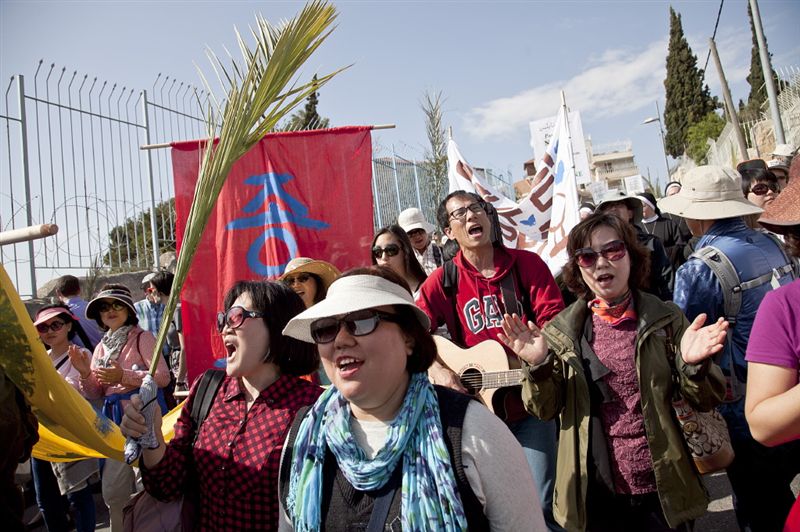
Palm Sunday in Jerusalem
Thousands of Pilgrims Converge on Jerusalem

Beginning at Catholic Church in Bethphage .
Crossing East Jerusalem and the Mount of Olives.
 down the Kidron Valley to the Old City
Led by Palestinian Scout Troops--Here from the Syrian Orthodox Church. 
Palestinian Christians still remain a small minority overshadowed by the thousands of pilgrims. Here young women from Beit Jala -- just seven kilometers away, but across the separation barrier-- were given permits for the Holy Days.
The irony: Christians from all over the world have free access to all the holy sites, but those from nearby need special permission.  In many cases, one spouse received a permit while the other did not.  And with the frequent closure of checkpoints during these holy days, permits were often meaningless pieces of paper.
Palm Sunday procession of priests in the Church of the Holy Sepulchre around the tomb.
Maundy Thursday


Catholic foot-washing ceremony at upper room.

Eucharist at the Lutheran Church of the Redeemer.


Procession from Redeemer to Gethsemane


Stay with me! Watch and Pray!


Good Friday on the Via Dolorosa 


Lutheran-Anglican Service at dawn.   Station V: Simon of Cyrene is compelled to carry Jesus' Cross


Pilgrims take up their cross to follow.

Good Friday Arabic meditation at Redeemer at sundown with Vicar Ashraf Tannous.
Easter Sunrise


Very early on the first day of the week, when the sun had risen, they went to the tomb. (Mark 16:2)


God breaking the silence:       He has been raised;     he is not here.


Go  and Tell!


photo credits: Ryan Roderick Beiler & Michael Younan
by Fred & Gloria Strickert
http://walkinjerusalem.blogspot.com/

Friday, March 30, 2012

Blind Bartimaeus

http://walkinjerusalem.blogspot.com/
by Fred & Gloria Strickert

“Teacher, order your disciples to stop.”
Jesus answered, "I tell you, if these were silent, the stones would shout out.”
(Luke’s Palm Sunday Gospel—Lk 19:40)


Just a few days before Palm Sunday and the beginning of Holy Week, while passing by Jericho on this way to Jerusalem, Jesus encountered Blind Bartimaeus  (Mark 10:46-52).  This was the last miracle of Jesus according to Mark’s Gospel.  Perhaps the most surprising part of the story is that “many sternly ordered him to be quiet,” trying to prevent healing for this unfortunate member of God’s creation.  Yet Bartimaeus only cried more loudly until he got Jesus' attention.

It happened again this week.   People trying to prevent “the recovery of sight to the blind.” And it happened near Jericho, at the Allenby Bridge border crossing from Jordan.

Dr. Ali Dabbagh, an eye-doctor with specialist credentials, was on his way to Augusta Victoria Hospital in Jerusalem to offer his third segment of a course on “Diabetes and Eye Complications.” 
And he was denied entry by Israeli security.  He tried another border crossing the next day, and was denied once again.

This is one of the many road blocks thrown up every day by a government of occupation in making life difficult for Palestinians.  It highlights even more the amazing story of our Lutheran ministry of health care to Palestinians at August Victoria Hospital--especially when one considers all the determination by health care providers and all their extraordinary efforts.  We were made aware of this story once again this week with the release of the LWF Jerusalem Annual Report --2011 (click the link to read the report or go to the website  www.lwfjerusalem.org ).

When you see a beautiful cover photo of a young Palestinian dialysis patient with her Winnie the Pooh coloring page, you can only feel proud about what the world-wide Lutheran community is doing to continue Jesus’ healing ministry.  You can also read the story of Asmah, a six-year old cancer patient who came to AVH from a refugee camp in Gaza.  On page 12, you can read about the celebration at AVH of World Diabetes Day and the hospital's focus on childhood diabetes—with funding assistance of USAid.


14 % of Palestinians suffer from diabetes, the high figure a result of the stress-filled life under occupation—and in many cases it affects the eyes, no different than the world Jesus encountered with Roman occupation.

 
There are 66 ophthalmologists and 12 eye specialists for the Palestinian community, but none have been trained in diabetic eye problems.  Thus the importance for a specialist like Dr. Dabbagh who is a British citizen working in a hospital in Kuwait.  For the last thirteen years he has been donating part of each year working with Palestinian patients, establishing the Oyooni Mobile Clinic.  (Click for the clinic's webpage)


And so the importance of Dr Dabbagh’s courses at Augusta Victoria Hospital.  What a gift he offers to diabetic patients throughout Gaza and the West Bank, and particularly those coming to AVH for treatment.

What a disappointment for those who had come to the hospital on Tuesday expecting to learn from  him.  What a tragedy for individuals who continue to suffer because of such unnecessary delays.

Fortunately the Israeli newspaper Haaretz reporter Amira Hass heard about the denial of entry of Dr. Dabbagh at the border this past Monday and again at another border crossing on Tuesday and decided to investigate. The reporter’s inquiry at the Israeli Interior Ministry provided the explanation that he “was refused entry at the recommendation of defense elements.”  As a result of her prodding, there was typical beaurocratic backtracking-- no he really wasn't a security risk-- and  eventually the decision was reversed.  

Haaretz published the Friday story Israel reverses decision denying entry to British-Palestinian humanitarian doctor.”  (Read the newspaper story here.)
By Thursday Dr. Dabbagh was finally allowed to enter--three days after his original planned arrival.  He was merely delayed.  One wonders how many others have experienced the same unwarranted roadblocks?  How many other humanitarians have been denied completely?

In the story of blind Bartimaeus, when many sternly ordered him to be quiet, he refused. Bartimaeus  cried out even more loudly, “Jesus, Son of David, have mercy on me!” 
 Let’s pray for more determined individuals like Dr. Dabbagh and for more voices like Haaretz’s Amira Hass to continue crying out even more loudly to bring an end to the occupation.
"I tell you, if these were silent, the stones would shout out.”

by Fred & Gloria Strickert

Saturday, March 24, 2012

Wilderness

http://walkinjerusalem.blogspot.com/
by Fred & Gloria Strickert

Jesus was in the wilderness forty days, tempted by Satan, and he was with the wild beasts; and the angels ministered to him.  Mark 1:13


Lent is the season for wilderness walking.


The perfect time for a congregational outing to the wilderness east of Jerusalem.

  
            A Picnic Lunch
One does not live by bread alone--a little peanut butter & nutella, please-                                                                       
Our destination: St. George's Monastery in Wadi Qelt --the valley cutting through the wilderness from Ramallah to Jericho.  In the 5th-6th centuries, over one hundred monasteries covered the wilderness landscape around Jerusalem and Bethlehem.

The hike down
The view from below
Beginning with the monk Chariton in 330 ce, Christians began the practice of a Lenten pilgrimage to the wilderness, living in caves in the rugged landscape and then joining together each Sunday in the monasteries for their weekly Eucharistic feast.  Note the date:  When Christianity was legitimized and became main-stream under Constantine, and when persecutions and hardships were less frequent, the faithful felt the need for such Lenten discipline.


Note the caves to right of Mona- stery.   Tradition said that Elijah stayed here on way to the Sinai.The monastery was destroyed several times and later rebuilt, most recently in the late 19th century.

The winter rains in Jerusalem and water from a spring transform the Wadi into an oasis. 

Inside the monastery chapel: Iconostasis with traditional Greek Orthodox icons.
Icon of St. George of Koziba and his relic box (skeleton)- the monastery's leader in the late sixth century. 

Playing with the monks' pet dog.
Women are welcome to visit St. George's, unlike many other Orthodox monasteries.  Tradition says that Joachim, the father of Mary of Nazareth, had retreated nearby when he learned that his wife Anna was pregnant with Mary.  Later in the 6th century, a Christian noblewoman following a vision of the Virgin Mary came here and was healed.
The view below 
The trek back up, by donkey.
Our wilderness trip was capped off by a visit to Nabi Musa, a Pilgrimage site of Palestinian Muslims in honor of the Prophet Moses.
Greetings from the Wilderness, with the Dead Sea in the background and Mount Nebo beyond the Jordan.

by Fred & Gloria Strickert

Photo credits: Laurin-Whitney Gottbrath & Anna Johnson